
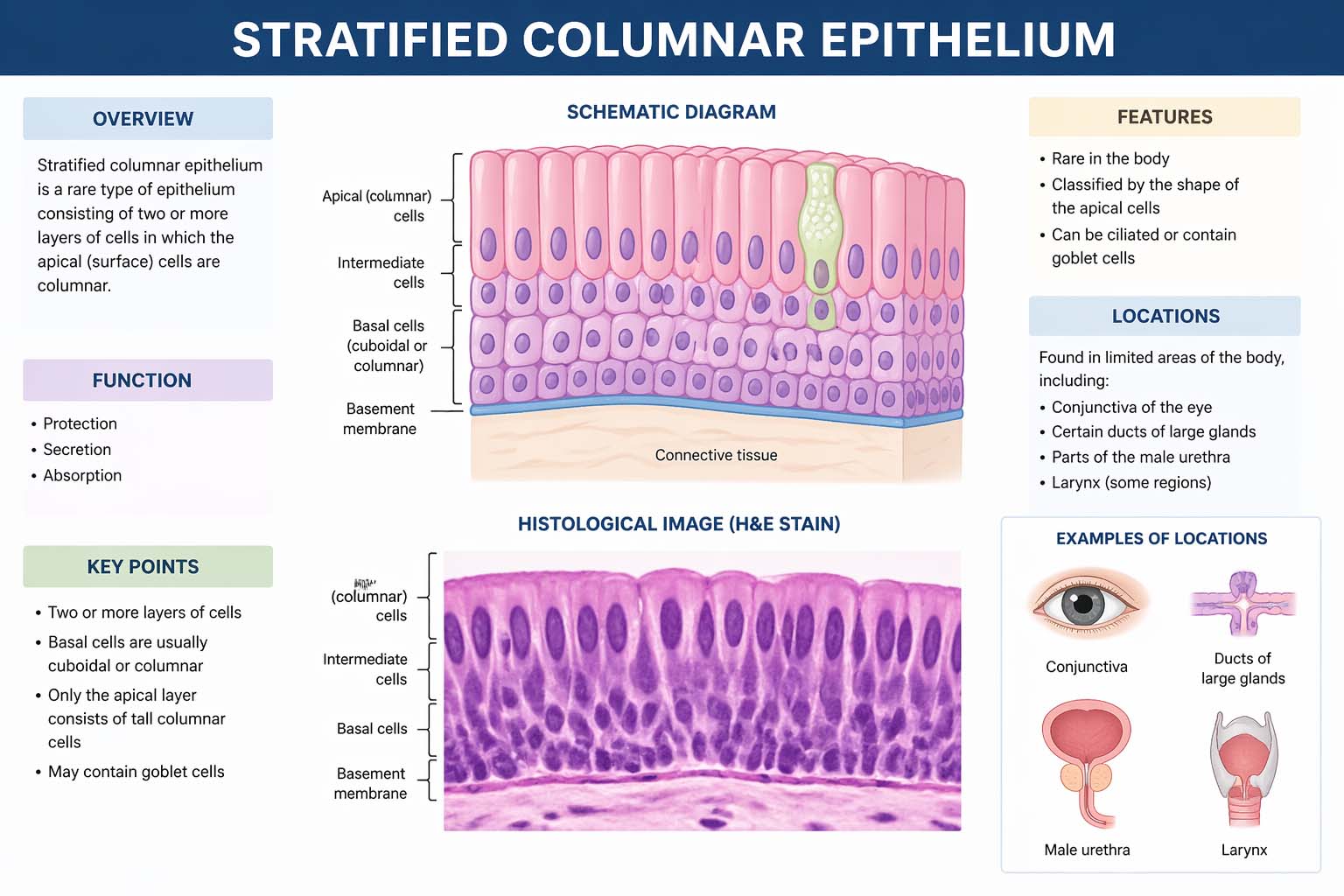
of epithelial tissue found in the human body. organs, and help protect sensitive structures. This particular tissue consists of multiple layers of cells, with the top layer made of column-shaped cells. Because of its structure, stratified columnar epithelium offers both protection and specialized support in certain body regions.
Although it is not as common as simple or stratified squamous epithelium, columnar epithelium is still important in anatomy and histology. Medical students and biology learners often study this tissue to understand how the body uses different cell types for specific jobs.
What Is Stratified Columnar Epithelium?
Stratified columnar epithelium is made of more than one cell layer. The surface cells are tall and column-like, while the deeper layers are usually cuboidal or irregular in shape. This layered arrangement gives the tissue added strength and durability.
The word “stratified” means layered, while “columnar” refers to the tall shape of the cells at the surface. Together, these features create a tissue that can protect delicate organs while also participating in secretion.
This tissue is uncommon compared to other epithelial tissues, but it plays an important role where extra protection is needed.
Structure of Stratified Columnar Epithelium
The structure ofis designed for support and defense. The lower layers of cells continuously divide and replace older surface cells. when damaged.
The uppermost cells are elongated and column-shaped. These cells may contain organelles involved in secretion or absorption depending on the organ in which they are found.
The basement membrane anchors the tissue to underlying connective tissue. Nutrients reach the cells through diffusion because epithelial tissues usually lack direct blood vessels.
Stratified Columnar Epithelium Function
The stratified columnar epithelium function mainly includes protection and secretion. Since it has multiple layers, it can guard underlying tissues from wear, irritation, and chemical stress.
In glands, this tissue helps with secretion of mucus or other substances. In ducts, it can strengthen the lining while allowing safe passage of fluids.
Because it is stronger than single-layer tissues, m is useful in places exposed to friction or repeated movement.
Function of Stratified Columnar Epithelium
The function of stratified columnar epithelium also includes maintaining the integrity of certain body passages. while helping tissues remain moist and functional.
For example, in glandular ducts, the tissue supports transport of secretions from glands to target areas. It can also reduce injury caused by movement of fluids through narrow channels.
This dual role of protection and secretion makes it unique among epithelial tissues.
Stratified Columnar Epithelium Location
The stratified columnar epithelium location in the body is limited to a few specialized areas. It is commonly found in parts of the male urethra, large ducts of some glands, and certain regions of the conjunctiva of the eye.
These areas need tissue that is tougher than simple epithelium but still capable of secretion or controlled transport. Because of this, appears only where its unique structure is beneficial.
Students often memorize these locations because they are frequently asked in anatomy and histology exams.
Where Is Stratified Columnar Epithelium Found?
If you are asking where is found, the answer includes several specific body sites. It may be seen in:
- Large excretory ducts of salivary glands
- Parts of the male urethra
- Some areas of the pharynx
- Conjunctiva of the eye in certain regions
- Rare glandular passages needing extra protection
Because it is uncommon, histology slides featuring this tissue are often highlighted in textbooks and laboratory classes.
Comparison With Other Epithelial Tissues
Stratified columnar epithelium differs from simple columnar epithelium because it has multiple layers instead of one. This gives it more strength but usually less absorption efficiency.
It also differs from stratified squamous , which has flat cells on the surface rather than tall columnar cells. Stratified squamous tissue is better for heavy friction areas such as the skin and mouth.
Compared with stratified cuboidal , the surface cells in m are taller and more specialized.
Importance in Medical Studies
Understanding m helps doctors, nurses, and laboratory professionals identify normal tissue and detect abnormalities. Changes in epithelial tissues may signal infection, inflammation, or cancer.
Pathologists examine tissue samples under microscopes to compare cell arrangement, layer thickness, and cell shape. Recognizing stratified columnar epithelium can help determine the origin of a sample.
For students, it is an important example of how tissue form relates to tissue function.
Disorders and Clinical Relevance
Although this tissue is rare, the organs containing it can develop disease. Inflammation, irritation, infections, or tumors may alter the normal appearance of epithelial cells.
For example, chronic irritation in ducts or urinary passages may lead to structural changes. Early diagnosis often depends on recognizing unusual cell patterns.
Healthy tissues depend on hydration, nutrition, and protection from toxins or infections.
Easy Way to Remember It
A simple way to remember = is:
- Stratified = many layers
- Columnar = tall surface cells
- Main roles = protection + secretion
- Found in = rare ducts and specific passages
This memory trick can help during biology exams or anatomy revision.
Conclusion
Stratified columnar epithelium is a rare but important epithelial tissue made of multiple layers with column-shaped surface cells. It provides protection, supports secretion, and lines certain specialized areas of the body.
Learning about function, location, and where is found helps students understand how body tissues are designed for specific tasks. Even though it is uncommon, it remains an essential topic in histology and human anatomy.