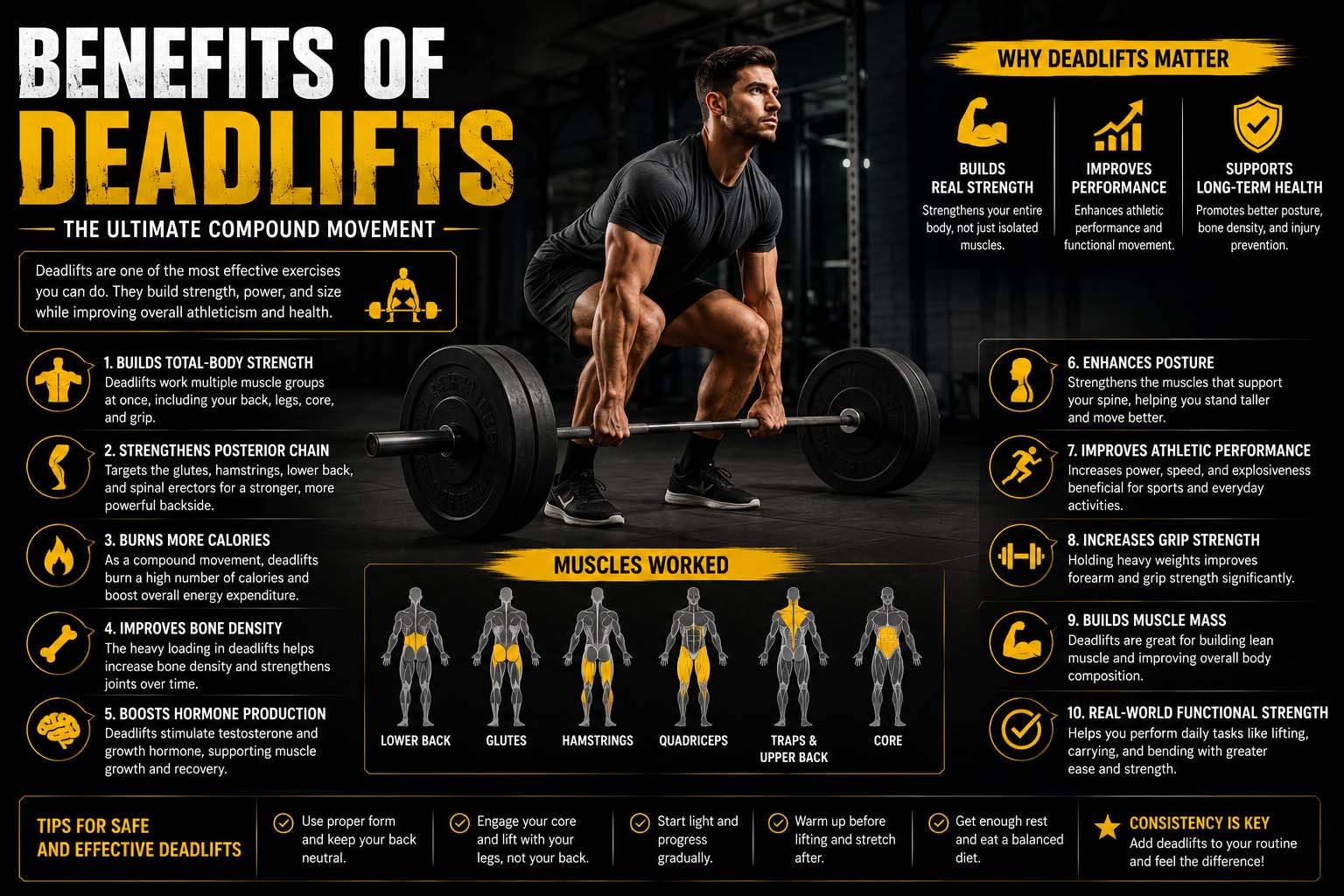
That exercise is the deadlift, and the benefits of deadlifts make it one of the most effective strength-training movements you can do.
Many people think deadlifts are only for powerlifters or bodybuilders, but that’s far from true. When performed with proper form, deadlifts can improve overall health, support better movement, build strength, and even make everyday activities feel easier.
So, what are the advantages of this exercise? In fact, the answer goes beyond bigger muscles. Deadlifts train your entire body, improve posture, strengthen bones, increase grip strength, and help you move more efficiently in daily life.
Whether you’re new to resistance training or looking to improve your current workout routine, understanding the health benefits of deadlifts can help you make informed fitness choices.
What Are the Benefits of Deadlifts?
Deadlifts are a compound resistance exercise that involves lifting weight from the floor while maintaining a stable spine and controlled movement.
Unlike isolation exercises that focus on one muscle, deadlifts work several major muscle groups at once.
Here are some of the biggest benefits:
| Benefit | How It Supports Health |
|---|---|
| Full-body strength | Builds functional muscle throughout the body |
| Better posture | Strengthens muscles that support the spine |
| Stronger bones | Weight-bearing exercise supports bone health |
| Improved grip | Develops hand and forearm strength |
| Core stability | Helps protect the lower back during movement |
| Muscle growth | Encourages lean muscle development |
| Better balance | Improves body control and coordination |
| Functional fitness | Makes everyday lifting easier |
Deadlifts Strengthen Nearly Every Major Muscle Group
One reason fitness professionals recommend deadlifts is because they activate multiple muscles during every repetition.
Primary muscles include:
- Glutes
- Hamstrings
- Quadriceps
- Lower back
- Upper back
- Core muscles
- Forearms
- Trapezius
- Latissimus dorsi
Therefore, training several muscles together improves overall strength while making workouts more efficient.
Additionally, people exploring other resistance exercises may find the benefits of a weighted vest relevant to their overall strength routine.
Improve Functional Strength for Everyday Life
Health isn’t only measured inside the gym.
In fact, functional strength means having the ability to safely perform everyday activities.
Deadlifts help prepare your body for movements like:
- Carrying grocery bags
- Lifting storage boxes
- Picking children up safely
- Moving furniture
- Gardening
- Household chores
Because the movement closely resembles lifting objects from the ground, it has practical value that carries over into daily life.
Support Better Posture
Many people spend hours sitting at desks, driving, or looking at screens.
Over time, weak back muscles and poor posture can contribute to discomfort and muscle imbalances.
Deadlifts strengthen:
- Spinal stabilizers
- Upper back
- Lower back
- Core
- Glutes
As a result, a stronger posterior chain helps support proper alignment and encourages better posture during daily activities.
Build a Stronger Core
You don’t need endless crunches to improve core strength.
During a deadlift, your abdominal muscles work hard to stabilize your spine throughout the movement.
This creates stronger:
- Deep abdominal muscles
- Obliques
- Lower back stabilizers
- Pelvic muscles
Therefore, strong core muscles provide better support for the spine, improve balance, and help the body transfer force more efficiently during physical activities. As a result, this can make everyday tasks feel easier while promoting better movement patterns.
Promote Healthy Bone Density
Resistance training places controlled stress on bones.
Over time, this encourages bones to remain stronger when paired with adequate calcium, vitamin D, and a balanced diet.
Therefore, weight-bearing exercises like deadlifts may play a role in supporting long-term bone health, especially when combined with an overall healthy lifestyle.
Additionally, people exploring nutrients for bone health may want to understand the benefits of d3 and k2.
Burn More Calories During Workouts
Deadlifts recruit large muscle groups, meaning your body works harder compared with many isolation exercises.
While deadlifts alone won’t cause weight loss, they can:
- Increase workout intensity
- Raise energy expenditure
- Support lean muscle development
- Help maintain muscle while losing body fat
Combined with healthy nutrition and regular activity, deadlifts can be part of an effective weight-management plan.
For example, understanding the best time to weigh yourself may help you monitor progress more consistently.
Improve Balance and Coordination
Deadlifts require several muscle groups to work together.
This improves:
- Coordination
- Body awareness
- Stability
- Movement efficiency
As a result, these improvements can benefit athletes, older adults, and anyone looking to reduce the risk of falls caused by poor balance.
Benefits of Deadlifts for Men
The benefits of deadlifts for men extend beyond building larger muscles.
Increase Total-Body Strength
Because deadlifts challenge multiple muscle groups simultaneously, they allow steady strength improvements over time.
Support Lean Muscle Growth
Combined with proper nutrition and recovery, deadlifts encourage muscle development throughout the body.
Improve Athletic Performance
These muscle groups help generate power, improve stability, and support efficient movement during high-intensity activities.
Encourage Better Posture
As a result, strengthening the upper and lower back helps counteract poor posture caused by prolonged sitting.
Benefits of Deadlifts for Women
The benefits of deadlifts for women make this exercise suitable for nearly every fitness level.
Strength Without Excessive Bulk
Women naturally build strength through resistance training without automatically developing excessive muscle size.
Stronger Glutes and Legs
In particular, deadlifts effectively train the glutes, hamstrings, and quadriceps.
Better Bone Health
Additionally, strength training supports healthy bones throughout adulthood.
Improved Confidence
Many women discover that lifting heavier weights safely increases confidence both inside and outside the gym.
Easier Daily Activities
As a result, carrying shopping bags, lifting children, and household tasks often become easier with improved strength.
Benefits of Sumo Deadlifts
The benefits of sumo deadlifts make this variation a popular choice for many lifters.
Unlike the conventional deadlift, the sumo deadlift uses:
- A wider foot stance
- Hands inside the knees
- A more upright torso
Reduced Stress on the Lower Back
For this reason, many people find the upright position more comfortable.
Greater Quadriceps Activation
The wider stance allows increased involvement from the front of the thighs.
Helpful for Certain Body Types
For example, some individuals with longer legs or limited hip mobility may find the sumo position more natural.
Strong Hip Development
Additionally, the movement strengthens the hips, glutes, and inner thigh muscles.
Conventional vs. Sumo Deadlift
| Feature | Conventional | Sumo |
|---|---|---|
| Foot Position | Narrow | Wide |
| Back Angle | More forward | More upright |
| Hamstring Focus | Higher | Moderate |
| Quad Activation | Moderate | Higher |
| Hip Mobility | Moderate | Higher |
| Best For | General strength | Reduced back stress for some lifters |
Neither variation is universally better. Instead, the best option depends on your body mechanics, mobility, and comfort.
Common Deadlift Mistakes
Learning proper form helps reduce injury risk and improves results.
Common mistakes include:
Rounding the Lower Back
Maintain a neutral spine throughout every repetition.
Lifting Too Heavy Too Soon
Above all, master technique before increasing weight.
Pulling With the Arms
Instead, your hips and legs should generate the lifting power.
Letting the Bar Drift Away
Keep the bar close to your body throughout the lift to improve control, maintain proper mechanics, and reduce unnecessary stress on your lower back. As a result, a closer bar path helps you use your muscles more efficiently and allows for a safer, stronger movement pattern.
Skipping Warm-Ups
Therefore, prepare your muscles with light movement before heavy lifting.
Who Should Be Careful With Deadlifts?
Deadlifts are safe for many healthy adults when performed correctly.
However, you should speak with a healthcare professional or qualified fitness expert before starting if you have:
- A recent back injury
- Severe osteoporosis
- Uncontrolled high blood pressure
- Recent surgery
- Persistent joint pain
- Pregnancy-related concerns about heavy lifting
Ultimately, individual guidance helps determine the safest exercise approach.
Wellness Tips for Better Deadlift Results
Healthy habits make every workout more effective.
Try to:
- Warm up for 5–10 minutes.
- Learn proper technique before adding weight.
- Increase resistance gradually.
- Prioritize sleep and recovery.
- Eat enough protein to support muscle repair.
- Stay hydrated before and after workouts.
- Include rest days in your weekly routine.
Additionally, choosing the best time to workout can help you build a routine that fits your schedule.
Likewise, if you use supplements to support muscle repair, selecting the best protein powder depends on your fitness goals and dietary needs.
Overall, consistency produces better long-term results than lifting heavy every session.
Myths About Deadlifts
Myth: Deadlifts Are Bad for Your Back
When performed with proper technique and appropriate weight, deadlifts strengthen the muscles that support the spine rather than automatically causing injury.
Myth: Only Athletes Should Deadlift
In fact, many beginners and recreational exercisers benefit from learning the movement safely.
Myth: Deadlifts Make Women Too Muscular
Strength training helps women build lean muscle, strength, and bone health. However, significant muscle growth requires years of focused training and nutrition.
Myth: You Must Lift Extremely Heavy
In fact, light and moderate weights can provide excellent health and fitness benefits while helping improve technique.
Frequently Asked Questions
How Often Should I Do Deadlifts?
Most people can include deadlifts once or twice each week, depending on their training program and recovery.
Are Deadlifts Good for Weight Loss?
They can support weight management by increasing calorie expenditure and preserving lean muscle when combined with a balanced diet.
Can Beginners Perform Deadlifts?
Yes. However, beginners should first learn proper form using light weights or even a training bar before progressing.
Do Deadlifts Improve Posture?
Yes. In fact, they strengthen the muscles that help support the spine and maintain better posture.
Are Deadlifts Enough for a Complete Workout?
Deadlifts are highly effective but work best as part of a balanced routine that includes pushing, pulling, mobility, and cardiovascular exercise.
Should I Choose Conventional or Sumo Deadlifts?
Ultimately, choose the variation that feels comfortable, allows good technique, and matches your training goals.
Key Takeaways
The benefits of deadlifts go far beyond lifting heavier weights. They improve full-body strength, support healthy posture, build a stronger core, encourage bone health, and make everyday movements easier.
Whether you’re interested in the benefits of deadlifts for men, exploring the benefits of deadlifts for women, or comparing the benefits of sumo deadlifts, this exercise offers lasting health value when performed correctly.
Start with light weights, focus on proper technique, and progress gradually. Over time, deadlifts can become one of the most rewarding exercises for building strength, improving movement, and supporting long-term wellness.