
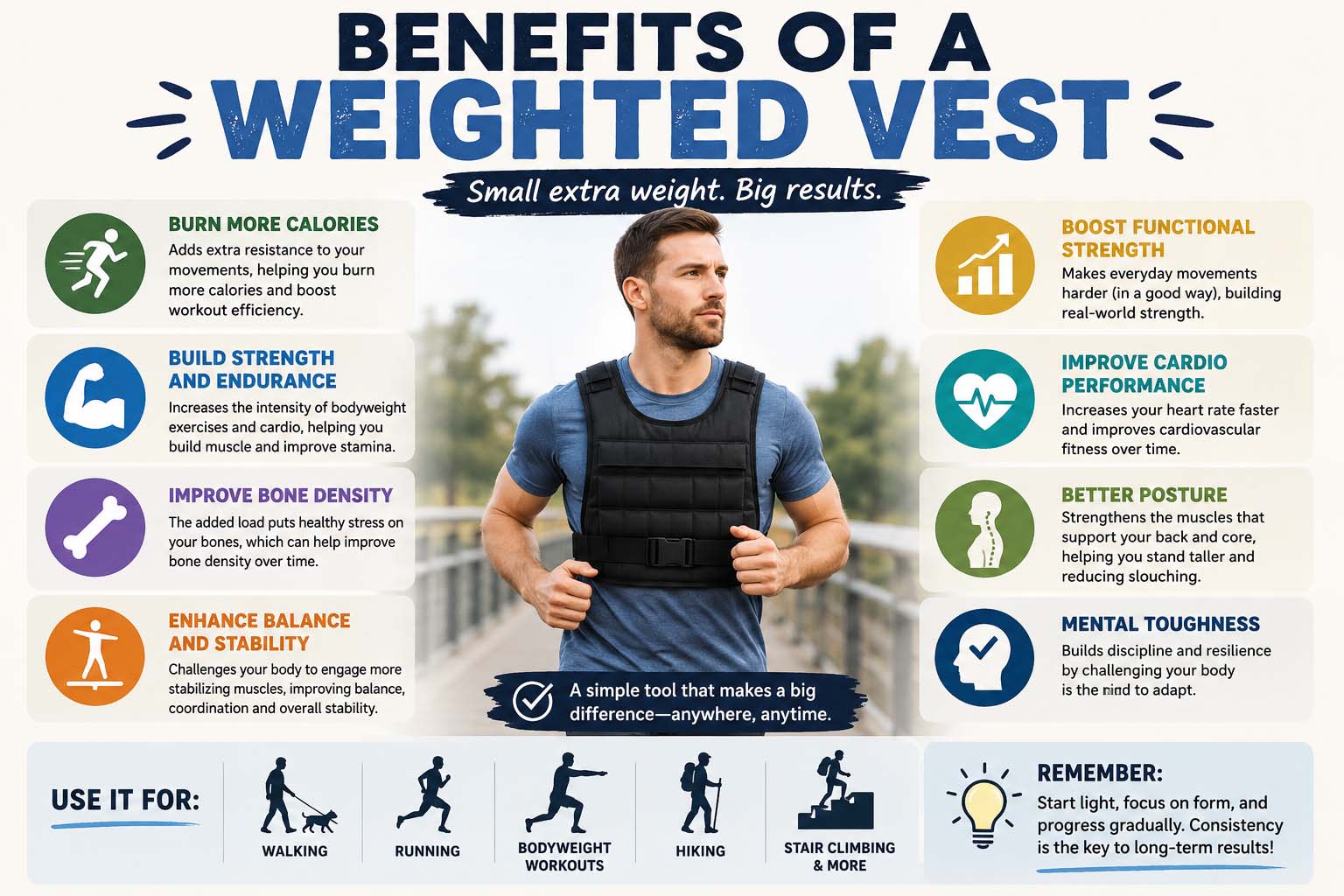
The benefits of a weighted vest can make familiar activities such as walking, bodyweight exercises, and conditioning workouts more challenging. By adding external resistance around the torso, a vest can increase the physical demand of selected movements without requiring a full set of gym equipment.
However, a weighted vest is not automatically better for every exercise or every person. The amount of weight, activity, fitness level, and training experience all matter. Therefore, beginners should focus on gradual progression instead of choosing the heaviest vest available.
What Is a Weighted Vest and How Does It Work?
A weighted vest is a wearable fitness accessory that adds external resistance around the torso. Most designs distribute the load across the front and back to help maintain balance during movement.
People commonly use weighted vests for:
- Walking
- Stair climbing
- Squats
- Lunges
- Push-ups
- Hiking
- Bodyweight training
- Selected conditioning workouts
Some models also use removable weights. As a result, users can adjust the resistance as their fitness improves or when they switch between activities.
What Are the Benefits of a Weighted Vest?
A weighted vest increases the load your body carries during movement. As a result, an activity that normally feels manageable can become more demanding.
Potential advantages include:
- Greater exercise intensity
- Higher energy expenditure during some activities
- Increased muscular demand
- More challenging bodyweight exercises
- Convenient resistance during walking
- Greater workout variety
- Hands-free resistance
- Portable training options
However, the results depend on the benefits of a weighted vest, vest load, training program, and individual. A vest works best as one part of a balanced fitness routine rather than as a replacement for aerobic activity or conventional resistance training.
Similarly, learning about the benefits of deadlifts can help you explore another form of resistance exercise.
Benefits for Walking and Everyday Activity
Walking is one of the simplest activities to combine with a weighted vest. Because your body must move additional mass, the same route and pace can feel more demanding.
The American College of Sports Medicine’s guidance on weighted vests explains that weighted vests can increase energy expenditure during walking. However, the organization also emphasizes that some popular claims about these products go beyond the available evidence.
Energy Expenditure During Weighted Walking
Carrying additional weight requires your body to perform more work while walking. Therefore, a weighted walk can use more energy than the same walk without additional resistance.
For example, ACSM reports that research has found increased energy expenditure when people walk with a weighted vest. However, this does not mean wearing one automatically produces weight loss. Body weight management also depends on eating patterns, total activity, sleep, and long-term habits.
Cardiovascular Demand
Extra resistance can make a familiar walking pace feel harder. Consequently, heart rate, oxygen use, and perceived effort may increase.
For people who already walk regularly, light resistance can provide one way to increase training demand without immediately increasing speed. Still, progression should remain gradual.
Muscular Demand
A vest increases the load supported by the lower body and trunk during each step. Therefore, the muscles involved in walking must manage additional resistance.
However, adding too much weight too quickly can increase discomfort and make normal movement more difficult. A manageable load is generally more useful than excessive resistance.
Using a Weighted Vest for Strength Training
A weighted vest can make familiar bodyweight exercises more challenging without requiring you to hold a dumbbell or barbell.
For example, users may add a vest to:
- Squats
- Lunges
- Push-ups
- Step-ups
- Stair climbing
- Selected pull-up variations
The additional load creates another progression option when bodyweight exercises become easier. However, good technique should come first.
Progressive Resistance
If you can perform an exercise comfortably with your body weight, a light vest may provide an additional challenge. For instance, someone who performs bodyweight squats with controlled technique can gradually introduce extra resistance.
First, master the movement. Then, add a manageable load and monitor your form. Increasing resistance before you can control the exercise can make poor movement patterns harder to correct.
Workout Variety
Repeating the same routine can eventually become monotonous. In contrast, appropriate external resistance can change the difficulty of familiar movements without requiring an entirely new program.
As a result, a vest can add variety to home workouts, outdoor sessions, and selected gym exercises.
Weighted Vest Training and Bone Health
People sometimes claim that walking with a weighted vest will significantly improve bone density. However, that claim needs careful context.
ACSM explains that ordinary walking, even with added weight, does not necessarily provide the high mechanical forces associated with stronger bone-building stimulus. Instead, appropriate impact activities and loaded resistance exercises can provide different forms of mechanical loading that support bone health.
Therefore, people who specifically want to improve or maintain bone health should not rely on weighted walking alone.
In addition, understanding the benefits of d3 and k2 can help you explore nutrition topics related to bone-focused wellness.
What About Running With a Weighted Vest?
Some experienced athletes use benefits of a weighted vest during running or conditioning. However, running already involves repetitive impact, so adding external weight requires more caution than adding resistance to controlled exercises.
The potential advantages include greater exercise intensity and additional muscular demand. At the same time, the extra load increases the amount of mass the body must manage with every stride.
Running Intensity
A vest makes the body move additional mass throughout the running cycle. Therefore, the same pace can feel harder than unweighted running.
That increased effort does not automatically make the workout better, though. Training should match the athlete’s experience, goals, and ability to maintain good running mechanics.
Muscular Demand
The legs and trunk must manage the additional resistance while running. As a result, the exercise can feel more demanding than running without extra weight.
However, more resistance is not always the most effective way to improve running performance. A structured training plan should determine how and when additional load fits into the routine.
Joint and Movement Stress
Additional weight can increase the forces the body manages during high-impact movement. Consequently, beginners should not treat weighted running as a necessary shortcut to better fitness.
Walking, stair climbing, and controlled bodyweight exercises can provide more manageable ways to introduce external resistance.
Weighted Vest Exercises for Beginners
Beginners should first become comfortable with an exercise without additional resistance. Once they can perform the movement with control, they can consider introducing a light vest.
Weighted Vest Walking
Walking offers a straightforward starting activity because you can control the pace, distance, and duration.
First, choose a comfortable route. Then, pay attention to posture, balance, and how your body responds to the added load. If the vest changes your normal walking pattern, reduce the resistance.
Weighted Squats
Squats train the lower body and trunk. Once you can perform them with controlled technique, a vest can add resistance while keeping your hands free.
Start with a manageable load and maintain a stable stance. If your technique changes noticeably, reduce the weight.
Weighted Push-Ups
A weighted vest can make push-ups considerably harder. Therefore, beginners should first develop consistent technique with regular push-ups.
Keep your torso controlled and avoid using the additional load if it causes your hips to sag or your range of motion to deteriorate.
Weighted Step-Ups
Step-ups combine lower-body strength, balance, and coordination. However, use a stable platform and controlled movement when wearing additional weight.
Consistency matters more than heavy resistance. Likewise, understanding the best time to workout may help you establish a routine that you can maintain.
How to Choose a Weighted Vest
A suitable vest should match the activity you plan to perform and allow comfortable, controlled movement.
Adjustable Weight
An adjustable model lets you change resistance between activities. For example, you may want a lighter load for walking and a different resistance level for controlled strength exercises.
This flexibility can also make gradual progression easier.
Secure Fit
The vest should remain reasonably stable during movement. Excessive bouncing can cause discomfort and interfere with exercise technique.
Look for adjustable straps or other features that help the vest stay in place while you move.
Breathable Construction
Exercise generates heat, particularly during longer sessions. Therefore, breathable materials and a comfortable design can make training more manageable.
Balanced Weight Distribution
Weight distribution also matters. A poorly balanced load can feel awkward and may affect posture or movement.
Before purchasing a vest, consider the exercises you plan to perform instead of focusing only on its maximum weight capacity.
Common Weighted Vest Training Mistakes
Using a weighted vest incorrectly can reduce the value of a workout and increase unnecessary discomfort.
Starting With Too Much Weight
Adding excessive resistance immediately can make familiar movements much harder than expected.
Instead, begin conservatively. Then, increase the challenge after your body has adapted to the current workload.
Ignoring Exercise Form
Extra resistance can make poor technique more difficult to control. Therefore, maintain steady posture and controlled movement throughout each exercise.
If your form deteriorates, reduce the load or stop the exercise.
Increasing Too Many Variables
Avoid increasing vest weight, workout duration, speed, and training frequency at the same time.
Instead, change one variable gradually. This approach makes it easier to identify how your body responds to the increased workload.
Wearing the Vest for Too Long
More time does not always produce better results. In fact, ACSM cautions against assuming that continuous benefits of a weighted vest-vest use throughout the day is beneficial. Prolonged use can create unnecessary musculoskeletal strain.
Therefore, treat the vest as a training tool rather than something you need to wear during every daily activity.
Starting With Weighted Running
Running with additional resistance can increase the physical demands of an already high-impact activity. Consequently, beginners should consider lower-impact options before attempting weighted runs.
Weighted Vest Safety and Warning Signs
A challenging workout can be normal, but pain should not be treated as proof that an exercise is effective.
Pay attention to symptoms such as:
- Persistent lower-back pain
- Knee pain
- Shoulder discomfort
- Unusual joint soreness
- Dizziness
- Excessive fatigue
- Changes in normal movement
If discomfort develops, reduce or remove the load and reassess your training. Persistent or concerning symptoms may require evaluation by an appropriate healthcare professional.
People with chronic health conditions, cardiovascular concerns, existing joint problems, balance difficulties, recent injuries, or significant back pain should seek individualized professional advice before substantially increasing exercise intensity.
Functional and Practical Uses
Some advantages of weighted-vest training come from its convenience. The vest adds resistance while leaving your hands free, which can suit walking, stair climbing, and selected bodyweight exercises.
More Challenging Everyday Movement
Walking, stair climbing, and controlled step-ups resemble movements used in everyday life. Therefore, adding suitable resistance can make these activities more demanding.
However, everyday movement does not always need additional weight. Use resistance when it supports a specific training goal.
Portable Resistance
A vest does not require a large exercise area or a weight rack. As a result, it can work well for suitable home, outdoor, or gym sessions.
Hands-Free Training
Unlike dumbbells, a vest keeps your hands available. This feature can make it convenient for certain bodyweight exercises and walking workouts.
Still, convenience should not replace proper exercise selection, technique, or progression.
Weighted Vest vs. Traditional Gym Equipment
Weighted vests and traditional resistance equipment serve different purposes.
| Weighted Vest | Traditional Equipment |
|---|---|
| Wearable and portable | Often requires dedicated space |
| Keeps the hands free | May require holding or gripping weight |
| Useful for selected bodyweight movements | Offers a broad range of resistance exercises |
| Can increase walking intensity | Often provides more precise resistance changes |
| Convenient for some outdoor workouts | Better suited to many isolated exercises |
A vest can complement traditional training rather than replace it.
For example, free weights and machines may provide better control when the goal is to progressively train specific muscle groups. On the other hand, a vest can suit someone who wants additional resistance during walking or bodyweight movements.
Who Should Use a Weighted Vest With Caution?
benefits of a weighted vest vests are not appropriate for every person or every activity.
People with health conditions, existing joint problems, balance difficulties, recent injuries, or significant back pain should seek individualized guidance before adding substantial external resistance. Likewise, anyone returning to exercise after a long period of inactivity should progress gradually.
A qualified healthcare professional or exercise specialist can help determine whether additional resistance fits your circumstances.
Tips for Safe Weighted Vest Training
Safe progression can help you gain the advantages of added resistance without making workouts unnecessarily difficult.
Start Conservatively
Choose a load that allows you to maintain normal movement and posture. Then, increase the challenge only after you have adapted comfortably.
Maintain Proper Technique
Proper movement matters more than the amount of weight in the vest. Therefore, reduce the resistance if your posture or exercise form begins to deteriorate.
Increase Resistance Gradually
Increase resistance, duration, or exercise difficulty gradually rather than changing everything at once.
For example, you might increase the duration of a walking session before adding more weight. This approach gives you a clearer indication of how your body responds.
Allow Recovery
Harder training requires adequate recovery. Therefore, give your body time to adapt between demanding sessions.
Recovery needs vary according to the activity, resistance, training volume, and individual fitness level.
Build a Complete Fitness Routine
A weighted vest is only one training tool. In addition, a balanced routine can include aerobic activity, strength training, mobility work, and adequate recovery.
Choosing the best protein powder may also help you evaluate supplement options according to your dietary needs and fitness goals.
Likewise, exploring when is the best time to workout can help you compare different exercise timing approaches.
Frequently Asked Questions
What Are the Main Benefits of a Weighted Vest?
A benefits of a weighted vest vest can increase exercise intensity, energy expenditure during some activities, muscular demand, and the difficulty of selected bodyweight exercises.
However, the actual effect depends on the activity, resistance level, fitness level, and overall training program.
Are Weighted Vests Good for Walking?
Yes. A vest can make walking more demanding because your body must move additional mass. As a result, the same route and pace may require more effort.
However, beginners should introduce resistance gradually and reduce the load if it affects normal walking mechanics.
Can Beginners Train With a Weighted Vest?
Yes, some beginners can use one appropriately. However, they should first become comfortable with the underlying activity and then introduce resistance gradually.
Good technique should remain the priority throughout the progression.
What Are the Benefits of Running With a Weighted Vest?
Weighted running can increase exercise intensity and muscular demand. However, it also increases the load the body must manage during an already high-impact activity.
Therefore, beginners may find walking or controlled resistance exercises more appropriate starting options.
Can a Weighted Vest Help Burn More Calories?
A weighted vest can increase energy expenditure during activities such as walking because the body must move additional weight.
However, the effect varies according to factors such as vest load, body size, speed, terrain, and workout duration. Weight management also depends on overall activity and eating patterns.
Does Weighted Walking Improve Bone Density?
People should not assume that weighted walking alone will substantially improve bone density. ACSM explains that walking with additional weight does not provide the same mechanical stimulus as higher-impact activities and loaded resistance exercises.
Therefore, people focused on bone health should use a broader exercise approach rather than relying on a vest alone.
How Heavy Should a Beginner’s Weighted Vest Be?
There is no single load that works for every beginner. Appropriate resistance depends on body size, fitness level, exercise choice, health, and training experience.
Therefore, start with a manageable load that does not disrupt posture or movement quality. After adapting to it, increase the resistance gradually if appropriate.
Final Thoughts
The main advantages of a weighted vest come from adding resistance to suitable activities. This can increase exercise intensity, energy expenditure, and muscular demand during walking, stair climbing, and selected bodyweight exercises.
However, heavier is not automatically better. Good technique, appropriate exercise selection, gradual progression, and recovery remain essential.
For beginners, starting conservatively provides a practical way to learn how additional load affects movement. Over time, a weighted vest can become one useful component of a broader fitness routine rather than a replacement for well-rounded exercise.