
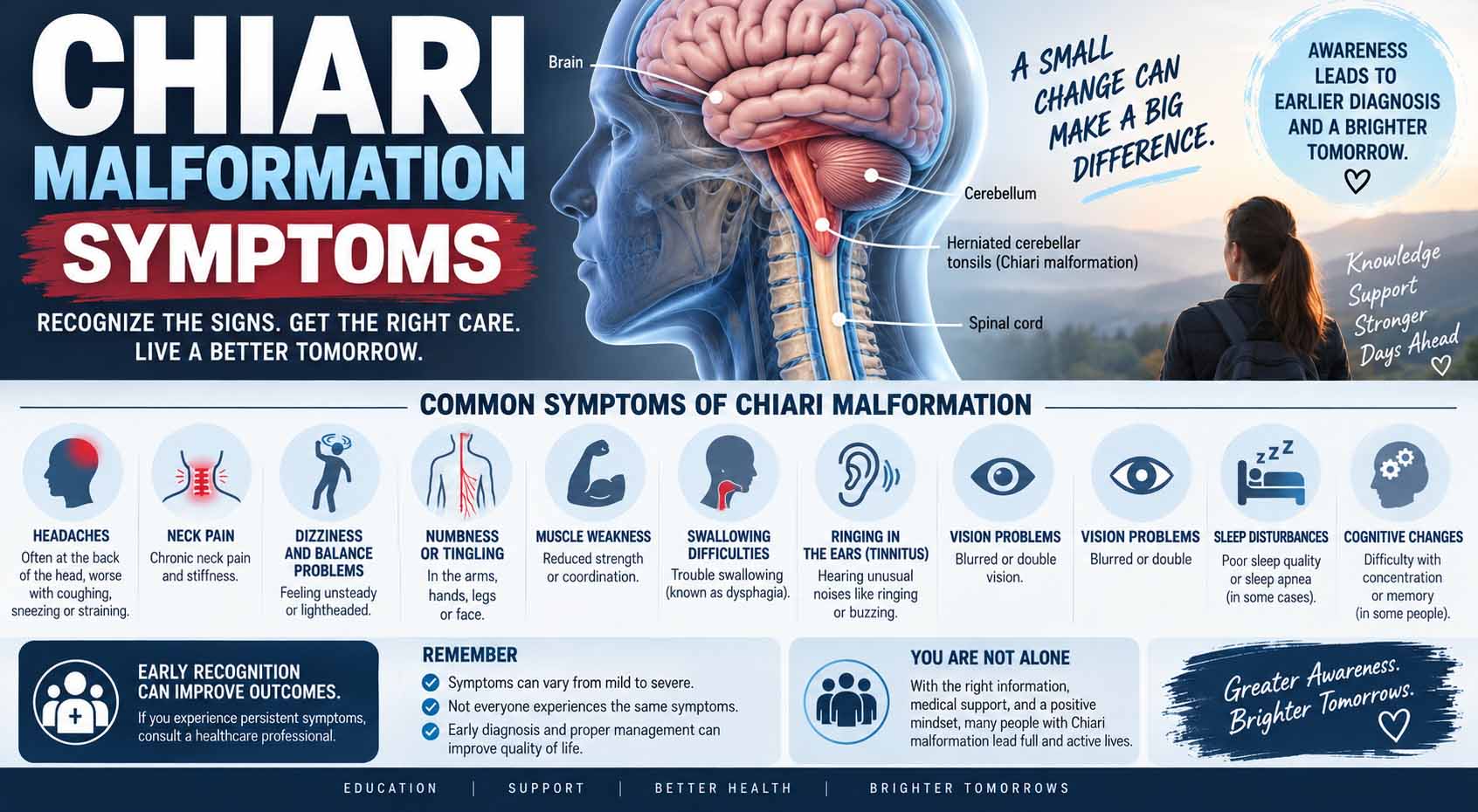
Chiari malformation affects the area where the brain and spinal cord meet, and its effects can vary widely from one person to another. Chiari malformation symptoms may include headaches, neck pain, dizziness, balance problems, numbness, swallowing difficulties, or other neurological issues. However, some people have no noticeable symptoms at all. Because many of these problems can also occur with other conditions, symptoms alone cannot confirm Chiari malformation, and medical evaluation is needed for an accurate diagnosis.
What Is Chiari Malformation?
Chiari malformation is a structural condition in which part of the cerebellum extends through the opening at the bottom of the skull, called the foramen magnum, and into the upper spinal canal.
The cerebellum sits toward the back and bottom of the brain and helps coordinate balance and movement. Meanwhile, the nearby brainstem controls many essential functions and connects the brain with the spinal cord.
Several types of Chiari malformation exist. However, Chiari I is the type most commonly identified in adolescents and adults. It may be present from birth, although symptoms sometimes do not appear until much later.
In fact, some people discover Chiari I unexpectedly after having an MRI for an unrelated reason.
Common Chiari Malformation Symptoms
The symptoms of Chiari malformation depend on several factors, including its type, the anatomy involved, whether cerebrospinal fluid flow is disrupted, and whether related problems such as syringomyelia are present.
Headache is one of the better-known symptoms. In particular, some people experience pain at the back of the head that becomes worse after coughing, sneezing, laughing, bending, or straining.
For someone whose head hurts when i cough, however, Chiari malformation is only one possible explanation. Cough-triggered headaches can have different causes, so recurring, severe, or unusual headaches should be evaluated rather than self-diagnosed.
Other possible symptoms include:
- Neck pain
- Dizziness or vertigo
- Balance difficulties
- Poor coordination
- Numbness or tingling
- Muscle weakness
- Swallowing difficulties
- Hoarseness
- Ringing in the ears
- Vision problems
- Sleep-related breathing problems
- Problems with fine motor control
Not everyone experiences the same combination. Likewise, symptom severity does not always correspond neatly with what an MRI appears to show.
Why Does Chiari Malformation Cause Headaches?
Chiari-related headaches often involve the back of the head or upper neck. Typically, activities that briefly increase pressure inside the head, such as coughing or straining, can trigger or worsen them.
Doctors sometimes describe these as cough or Valsalva-related headaches. The pain may become intense quickly and then improve, although headache patterns vary between individuals.
Still, having frequent headaches does not automatically indicate Chiari malformation. Migraine, tension-type headache, sinus problems, medication effects, dehydration, infections, and many other conditions can cause head pain.
Therefore, general advice about how to get rid of a headache may help with some ordinary headaches, but recurrent headaches triggered by coughing or straining deserve medical attention, especially when neurological symptoms occur at the same time.
Chiari Malformation Symptoms in Adults
Chiari malformation symptoms in adults can appear gradually, and their nonspecific nature may initially make the cause difficult to recognize.
Head and neck pain are common complaints. Meanwhile, some adults report dizziness, unsteadiness, weakness, numbness, or problems coordinating their hands.
Symptoms can include:
| Symptom | How It May Present |
|---|---|
| Headache | Often at the back of the head and sometimes triggered by coughing or straining |
| Neck pain | Aching or pressure near the upper neck |
| Dizziness | Lightheadedness, spinning sensations, or unsteadiness |
| Balance problems | Difficulty walking steadily or coordinating movement |
| Numbness or tingling | May affect the hands, arms, legs, or other areas |
| Weakness | Reduced strength or difficulty with certain movements |
| Swallowing problems | Choking, coughing, or difficulty swallowing |
| Vision changes | Blurred or double vision in some people |
| Tinnitus | Ringing or buzzing in the ears |
| Sleep problems | Snoring or sleep-related breathing disturbances in some cases |
These symptoms overlap with many neurological, inner-ear, musculoskeletal, and other medical conditions. Consequently, an MRI and clinical assessment are usually needed when Chiari malformation is suspected.
Symptoms of Chiari Malformation in Children
The symptoms of Chiari malformation in children depend partly on the child’s age and the specific type of malformation.
Older children may experience headaches, neck pain, dizziness, balance problems, weakness, or numbness similar to adults. However, younger children and infants cannot always describe pain or unusual sensations clearly.
As a result, caregivers may notice feeding problems, swallowing difficulty, gagging, abnormal breathing, excessive drooling, unusual crying, weakness, developmental concerns, or changes in coordination.
Children may also develop scoliosis, especially when Chiari malformation occurs with syringomyelia.
Because these signs can have many causes, a pediatrician or pediatric neurological specialist should assess persistent neurological, swallowing, breathing, developmental, or balance problems.
What Are the Weird Symptoms of Chiari Malformation?
People searching for weird symptoms of Chiari malformation are often referring to less obvious neurological experiences that seem unrelated to the head or neck.
For example, some people may experience ringing in the ears, tingling sensations, problems with hand coordination, swallowing changes, altered balance, or unusual sensations in the arms and legs.
However, these symptoms are not unique to Chiari malformation. Similar problems can arise from many neurological conditions.
For comparison, charcot–marie–tooth disease symptoms can also involve weakness, sensory changes, and coordination difficulties, although Charcot-Marie-Tooth disease is a distinct inherited peripheral nerve disorder with a different underlying cause.
Therefore, unusual neurological symptoms should be evaluated based on the complete clinical picture rather than matched to a single condition through an online symptom list.
Chiari Malformation and Syringomyelia
Some people with Chiari malformation develop syringomyelia, which means a fluid-filled cavity, called a syrinx, forms within the spinal cord.
A syrinx can place pressure on spinal cord tissue. Consequently, it may produce symptoms beyond headache and neck discomfort.
Possible problems include weakness, stiffness, numbness, altered temperature or pain sensation, and problems involving the arms or hands. In some cases, scoliosis may also occur.
Doctors may therefore examine both the brain and spinal cord with MRI when symptoms or imaging findings suggest that syringomyelia could be present.
Not every person with Chiari malformation develops a syrinx, though, and its presence can affect treatment decisions.
How Chiari Symptoms Differ From a Concussion
Some neurological symptoms overlap between different medical conditions. For instance, headaches, dizziness, balance difficulties, vision changes, and concentration problems can occur after a head injury.
However, symptoms of a concussion generally develop after trauma or a force that affects the brain, whereas Chiari malformation is a structural condition involving the lower part of the brain and skull.
The timing and circumstances therefore provide useful clues.
If symptoms begin after a significant head injury, especially with worsening headache, repeated vomiting, confusion, weakness, seizure, or loss of consciousness, prompt medical assessment is appropriate.
Likewise, a person who already has Chiari malformation should not automatically assume every new neurological symptom comes from Chiari.
What Causes Chiari Malformation?
Chiari malformations can have different causes depending on the type.
Chiari I is often related to structural development of the skull and brain. In some people, the space at the back of the skull may be relatively small, which can contribute to downward displacement of cerebellar tissue.
Less commonly, a Chiari-like downward displacement can develop secondary to another condition that changes pressure around the brain or spinal cord.
Family patterns have also been reported, suggesting genetics may contribute in some cases. However, inheritance is not straightforward, and having a relative with Chiari does not mean another family member will necessarily develop it.
How Doctors Diagnose Chiari Malformation
Diagnosis usually starts with a medical history and neurological examination.
A clinician may ask about headache location, triggers, balance, sensation, muscle strength, swallowing, vision, sleep, and other neurological symptoms.
MRI is the main imaging method used to evaluate Chiari malformation. It provides detailed images of the brain, skull base, spinal cord, and surrounding structures.
Doctors can use MRI to evaluate the position of cerebellar tissue and look for associated conditions such as syringomyelia.
However, imaging findings should be considered alongside symptoms and examination results. A person can have anatomical features consistent with Chiari I without experiencing symptoms that require treatment.
In selected cases, doctors may use specialized MRI techniques to assess cerebrospinal fluid movement near the skull base.
When Do Chiari Malformation Symptoms Need Treatment?
Treatment depends on symptoms, neurological findings, imaging results, associated conditions, and how the problem changes over time.
If Chiari malformation is discovered accidentally and causes no symptoms, a specialist may recommend observation rather than immediate treatment.
For people with mild symptoms, doctors may focus on symptom management and follow-up. However, persistent neurological problems, significant symptoms, worsening function, or complications such as syringomyelia may lead to consideration of surgery.
The most common surgical approach is posterior fossa decompression. The goal is to create more space near the lower brain and improve cerebrospinal fluid flow.
Still, surgery is not appropriate for every patient. A neurosurgeon considers the individual’s symptoms, anatomy, imaging, expected benefits, and surgical risks before recommending treatment.
Can Chiari Malformation Symptoms Get Worse?
Symptoms can remain stable for long periods in some people, while others may experience progression.
New weakness, worsening balance, increasing numbness, swallowing problems, changes in bladder or bowel control, or other neurological changes deserve medical evaluation.
Likewise, symptoms should not automatically be attributed to an existing Chiari diagnosis. A new medical problem may be responsible, so significant changes should be assessed on their own merits.
Regular follow-up may be recommended for certain patients, particularly when neurological symptoms or associated spinal cord abnormalities are present.
When Should You Seek Medical Care?
Make a medical appointment if you develop persistent headaches that are unusual for you, especially when coughing or straining repeatedly triggers them.
You should also discuss persistent dizziness, balance problems, numbness, weakness, swallowing difficulties, or unexplained coordination changes with a healthcare professional.
Seek urgent medical attention for sudden or rapidly worsening neurological symptoms, such as severe new weakness, major difficulty walking, serious breathing or swallowing problems, loss of consciousness, or other signs of a medical emergency.
Because Chiari symptoms overlap with many other disorders, getting the correct diagnosis matters more than trying to identify the condition from symptoms alone.
Frequently Asked Questions
What are the first symptoms of Chiari malformation?
There is no universal first symptom. However, some people first notice headaches at the back of the head or upper neck, particularly after coughing, sneezing, or straining. Others may first experience dizziness, balance changes, numbness, or another neurological symptom.
Can you have Chiari malformation without symptoms?
Yes. Some people with Chiari I have no symptoms and discover the condition incidentally during MRI imaging performed for another reason.
Where does a Chiari headache usually hurt?
Chiari-associated headaches commonly affect the back of the head and may extend into the upper neck. Coughing, sneezing, laughing, bending, or straining can sometimes make the pain worse.
Can Chiari malformation cause dizziness?
Yes, dizziness and balance difficulties can occur. However, both symptoms have many possible causes, including inner-ear conditions, medications, blood-pressure changes, migraine, and other neurological problems.
Can Chiari malformation cause numbness?
It can. Some people experience numbness, tingling, weakness, or changes in sensation, particularly when the spinal cord is affected or syringomyelia is present.
Is Chiari malformation life-threatening?
Many people with Chiari I live without severe complications, and some never develop symptoms. However, certain forms and complications can cause serious neurological, swallowing, or breathing problems. Therefore, individual medical evaluation is necessary to understand the actual risk.
Practical Next Steps
Chiari malformation symptoms can range from characteristic cough-triggered headaches to balance problems, dizziness, weakness, numbness, swallowing difficulties, and other neurological changes. Yet, the wide range of possible symptoms also means that many other conditions can look similar.
Therefore, symptoms should be treated as clues rather than proof of Chiari malformation. If headaches repeatedly worsen with coughing or straining, or if you develop persistent neurological changes, discuss them with a qualified healthcare professional. A clinical examination and appropriate imaging can determine whether Chiari malformation or another condition is responsible.