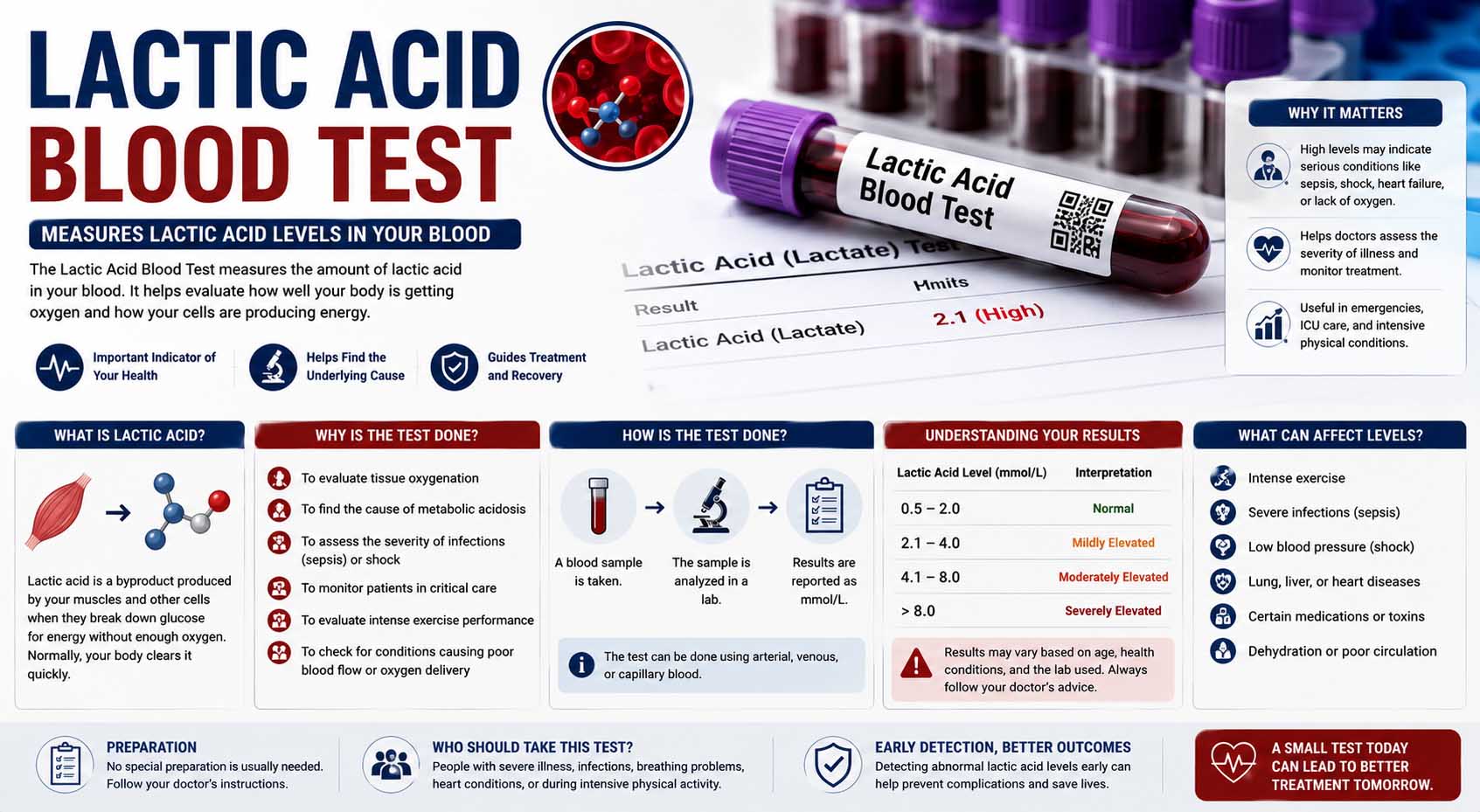
A lactic acid blood test measures the amount of lactate in your blood and can help doctors assess whether your body’s tissues may not be getting or using enough oxygen, or whether another condition is causing lactate to build up. Doctors often order the test when someone is seriously ill, has symptoms suggesting poor circulation or severe infection, or has another medical condition that could affect lactate production or clearance. A high result can be significant, but the number alone does not reveal the cause.
Your muscles and other tissues continuously produce some lactate. Usually, your body clears it efficiently, especially through the liver and kidneys. However, levels can rise when production increases, clearance decreases, or both happen at the same time.
What Is Lactic Acid in Blood Test Results?
Although people commonly call it “lactic acid,” laboratories generally measure lactate in the blood. Lactate forms during normal energy metabolism and is not automatically a sign that something is wrong.
Your cells normally use oxygen and nutrients to make energy. However, when oxygen delivery cannot meet tissue needs, lactate production may increase. Lactate can also rise for reasons that do not involve low oxygen, including certain medications, liver dysfunction, metabolic conditions, and intense physical activity.
Therefore, doctors interpret the result in context rather than treating it as a stand-alone diagnosis.
A lactate measurement may appear on a laboratory report as lactate, lactic acid, plasma lactate, or serum lactate, depending on the laboratory.
Why Is a Lactic Acid Blood Test Ordered?
Doctors usually order a lactic acid blood test when they need information about a person’s metabolic state or tissue perfusion. It is particularly useful in emergency and hospital settings.
For example, the test may be ordered when doctors suspect sepsis, shock, severe infection, impaired circulation, or another serious condition. It can also help monitor someone who is already receiving treatment.
Possible reasons for testing include:
- Suspected sepsis or severe infection
- Shock or very low blood pressure
- Severe dehydration or reduced circulation
- Significant breathing problems
- Certain seizures
- Some medication-related complications
- Suspected metabolic disorders
- Monitoring response to treatment
Because breathing and acid-base balance can also provide useful clues in seriously ill patients, a carbon dioxide blood test may be reviewed alongside other laboratory results when clinicians assess metabolic or respiratory problems.
However, each test measures something different, so one cannot replace the other.
What Is a Lactic Acid Serum Blood Test?
A lactic acid serum blood test is a laboratory measurement used to determine the amount of lactate in a blood sample. Depending on the facility and testing method, lactate may be measured from venous or arterial blood, and laboratories may use plasma or whole-blood methods rather than serum.
The sample needs careful handling because lactate levels can change after blood collection. Therefore, laboratories follow specific collection, transport, and processing procedures to improve accuracy.
Exercise and prolonged muscle activity can temporarily increase lactate as well. For that reason, healthcare professionals may ask you to rest before collection when the clinical situation allows.
In emergency situations, however, testing usually occurs immediately because doctors need information quickly.
What Does a High Lactic Acid Blood Test Mean?
A high lactic acid blood test means the lactate concentration exceeds the laboratory’s reference range. Doctors call this hyperlactatemia. When elevated lactate occurs together with significant acid buildup and a low blood pH, the condition may be described as lactic acidosis.
However, elevated lactate and lactic acidosis are not exactly the same thing.
A person’s lactate may increase temporarily without causing severe acidosis. For instance, vigorous exercise can raise lactate because working muscles rapidly increase energy production.
In a sick patient, though, elevated lactate can be an important warning sign. Therefore, doctors consider the result together with blood pressure, oxygen levels, symptoms, organ function, medications, and other laboratory findings.
Common Causes of High Lactate Levels
There is no single explanation for elevated lactate. Instead, doctors generally consider whether the body is producing excess lactate, having difficulty clearing it, or experiencing both problems.
Reduced Oxygen Delivery or Blood Flow
Lactate can increase when tissues receive inadequate blood flow or oxygen. For example, shock caused by severe infection, major blood loss, or serious heart problems can impair tissue perfusion.
Severe respiratory problems may also contribute in some situations. However, an abnormal lactate result does not automatically prove that tissues are oxygen-starved.
Severe Infection and Sepsis
Doctors commonly measure lactate when evaluating patients with suspected sepsis. Sepsis can cause complex changes in circulation and cellular metabolism, and elevated lactate may help clinicians assess severity and guide management.
Still, lactate cannot diagnose sepsis by itself. Doctors need the person’s symptoms, examination, vital signs, laboratory results, and suspected or confirmed infection to make clinical decisions.
Seizures and Intense Exercise
A generalized seizure can cause a temporary rise in lactate because muscles become extremely active. Likewise, strenuous exercise can increase lactate production.
In these situations, the level may fall relatively quickly after the intense muscle activity ends, depending on the person’s overall health.
Liver Problems
The liver plays a major role in processing lactate. Therefore, severe impairment of liver function may reduce the body’s ability to clear it.
Kidney function can also contribute to lactate metabolism and clearance. As a result, clinicians often consider overall organ function when investigating persistent elevations.
Medications and Metabolic Causes
Certain medications or toxins can contribute to elevated lactate under specific circumstances. For example, metformin-associated lactic acidosis is a rare but serious complication, with risk rising in certain situations such as severe kidney dysfunction or critical illness.
Other metabolic disorders may also affect lactate production. Therefore, medication history and existing health conditions matter when interpreting the test.
Lactic Acid Blood Test High: What Happens Next?
When a lactic acid blood test high result appears, the next step depends heavily on the patient’s condition.
For someone who has just completed intense exercise, a temporary elevation has a very different meaning from the same result in someone with low blood pressure, fever, confusion, and difficulty breathing.
Doctors may repeat the lactate measurement to see whether the number rises or falls. In some acute illnesses, a downward trend after treatment can provide useful information about the patient’s response.
Clinicians may also order a CBC to evaluate blood cells. For example, an nrbc blood test result can provide information about nucleated red blood cells when these immature cells appear in circulating blood, particularly in certain serious illnesses or hematologic conditions.
Still, laboratory trends should always be interpreted alongside the person’s clinical condition.
Symptoms That May Occur With Lactic Acidosis
Lactic acidosis can occur as part of a serious underlying medical problem. Therefore, symptoms can vary considerably depending on the cause.
Possible symptoms may include rapid breathing, weakness, nausea, vomiting, abdominal discomfort, unusual fatigue, confusion, or feeling severely unwell.
However, none of these symptoms specifically proves that lactate is elevated.
More concerning signs include severe shortness of breath, altered consciousness, very low blood pressure, cold or clammy skin, or signs of shock. These symptoms need urgent medical evaluation rather than home monitoring.
How Lactic Acid Blood Testing Is Performed
A healthcare professional collects a blood sample, usually from a vein, although arterial blood may be used in certain clinical settings.
The collection itself usually takes only a few minutes. You may feel a brief sting when the needle enters the skin, followed by mild pressure.
Because muscle activity can influence lactate, excessive fist clenching during blood collection may affect results. Therefore, collection techniques may be adjusted to reduce factors that could artificially increase the measurement.
Laboratories also process lactate samples according to specific protocols because delays or improper handling can alter the result.
Understanding Your Lactic Acid Blood Test Range
There is no single universal reference range that applies to every laboratory or specimen type. Consequently, always compare your result with the reference interval supplied by the laboratory that performed your test.
Many laboratories report lactate in millimoles per liter (mmol/L). However, reference limits can differ based on the testing method, sample source, and clinical setting.
A result slightly outside the listed range does not automatically indicate a medical emergency. Meanwhile, a significantly elevated result in a seriously ill patient may require rapid investigation and treatment.
Therefore, avoid judging the seriousness of your result from the number alone.
Other Blood Results Doctors May Review
Lactate is often only one part of a broader medical evaluation. Depending on your symptoms, clinicians may review electrolytes, glucose, kidney and liver markers, blood gases, bicarbonate or total carbon dioxide, and a complete blood count.
Platelet measurements may also be relevant in some illnesses. For example, understanding an mpv blood test high result can provide context about average platelet size, although MPV does not measure lactate and cannot determine why lactate is elevated.
Doctors may also use imaging, cultures, heart testing, or other investigations based on the suspected cause.
This broader approach matters because lactate tells clinicians that a physiological change may be occurring, but it rarely tells them exactly why.
How Is High Lactic Acid Treated?
There is no universal medication that simply lowers lactate for every patient. Instead, treatment targets the underlying cause.
For example, a patient with shock may require urgent measures to restore circulation. Meanwhile, someone with sepsis may need prompt treatment for the infection plus supportive medical care.
If a medication contributes to the problem, clinicians may adjust or stop it when appropriate. Likewise, severe dehydration, seizures, organ dysfunction, or metabolic conditions require treatment tailored to the specific cause.
As the underlying problem improves, lactate levels may fall.
Because serious lactic acidosis can become life-threatening, trying to treat a significantly elevated result with supplements, special foods, or home remedies is not appropriate.
Can You Prevent High Lactate Levels?
You cannot prevent every cause of elevated lactate. However, general health habits can reduce certain preventable risks.
For instance, staying appropriately hydrated supports normal circulation, especially during illness or physical activity. Likewise, taking prescription medications exactly as directed can reduce medication-related risks.
If you have kidney, liver, heart, lung, or metabolic disease, regular medical care can help identify changes before they become severe.
Exercise-related lactate is different. A temporary increase during vigorous activity is part of normal physiology and does not mean that exercise is damaging your body simply because lactate rises.
Common Myths About Lactic Acid
Myth: Lactate is simply a waste product
Lactate is part of normal human metabolism. In fact, the body can reuse it as an energy source and convert it into other useful compounds.
Myth: Lactic acid causes muscle soreness for days
Lactate produced during exercise clears relatively quickly. Therefore, the soreness that develops a day or two after unfamiliar or intense exercise is not caused by lactate remaining trapped in your muscles.
Myth: Every high lactate result means sepsis
Sepsis is one possible cause, but many other conditions can increase lactate. Consequently, doctors never diagnose sepsis based on lactate alone.
Myth: Drinking more water will correct lactic acidosis
Hydration may be helpful when dehydration contributes to illness, but serious lactic acidosis can have many causes. Therefore, it requires medical assessment and treatment directed at the underlying problem.
Frequently Asked Questions
What is lactic acid in blood test results?
The test measures lactate, a substance produced during normal energy metabolism. Doctors often use the measurement to assess seriously ill patients or investigate conditions that may increase lactate production or reduce its clearance.
Is a high lactic acid blood test always dangerous?
No. Exercise, seizures, and several other situations can temporarily raise lactate. However, a high result in someone who is acutely ill can signal a serious problem and needs appropriate medical interpretation.
Can dehydration raise lactic acid?
Severe dehydration can reduce circulating blood volume and tissue perfusion, which may contribute to increased lactate in some cases. Mild everyday dehydration does not automatically cause lactic acidosis.
Does high lactate mean I have low oxygen?
Not necessarily. Poor oxygen delivery is one cause of elevated lactate, but lactate can rise through several other mechanisms. Therefore, doctors assess oxygenation, circulation, organ function, medications, and other factors.
How quickly can lactate return to normal?
The timing depends on why it increased. Exercise-related elevations can fall relatively quickly after activity stops, while levels caused by serious illness may remain elevated until the underlying problem improves.
What to Do After Receiving Your Result
If your lactic acid blood test is abnormal, interpret it with the circumstances in which the test was ordered. A mildly abnormal measurement after intense physical activity is not equivalent to a high lactate level in someone who is severely ill.
If your doctor ordered the test during an illness, follow their recommendations for repeat testing, treatment, or further evaluation. Meanwhile, seek urgent medical care if you develop severe breathing difficulty, confusion, fainting, signs of shock, or rapidly worsening symptoms.
Most importantly, treat lactate as one clue rather than a diagnosis. When healthcare professionals combine the result with your symptoms, vital signs, medical history, and other tests, they can determine whether the elevation is temporary or points to a condition that needs prompt treatment.