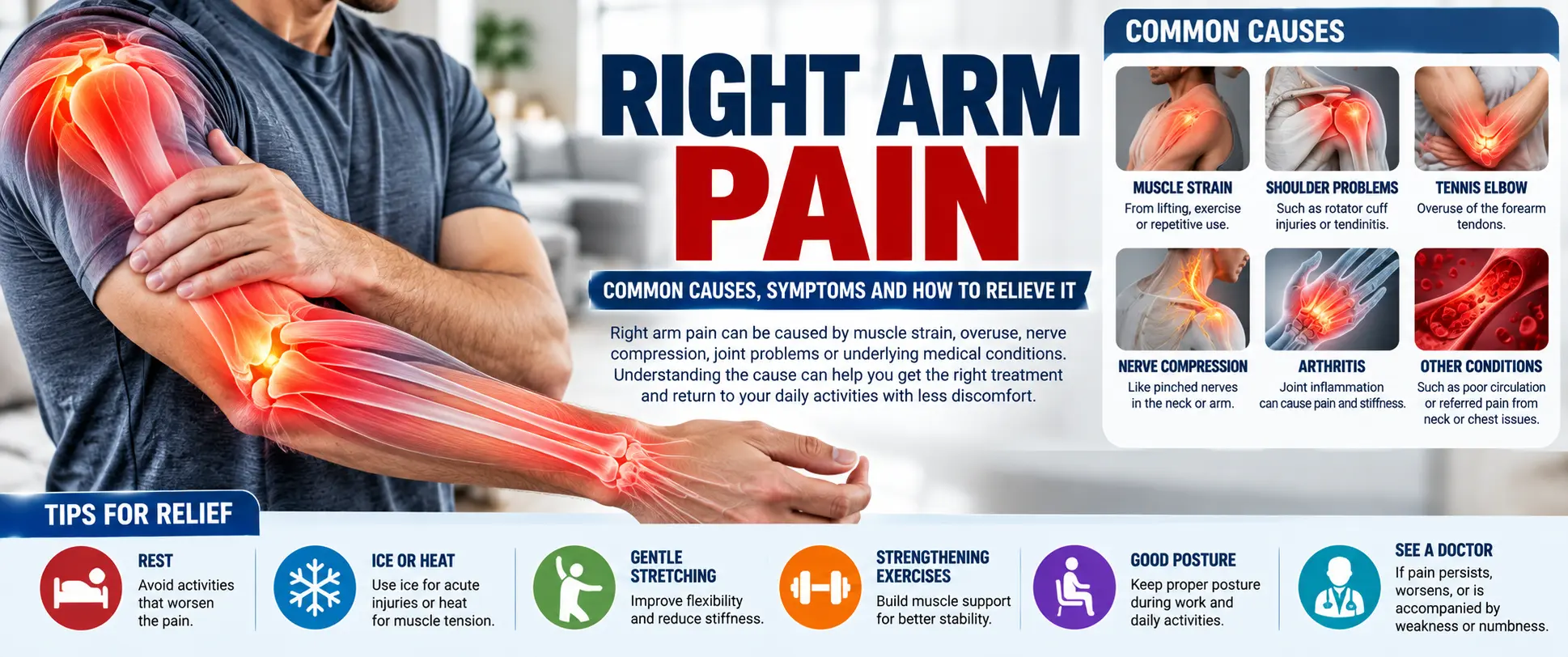
Right arm pain can come from something as simple as muscle overuse or an awkward sleeping position, but it can also develop from tendon injuries, joint problems, pinched nerves, or other medical conditions. Where the pain occurs, how suddenly it starts, and whether you have weakness, numbness, chest discomfort, or other symptoms can provide useful clues. Because arm pain has many possible causes, persistent, severe, or unexplained symptoms deserve proper medical evaluation.
Some people notice a dull ache after lifting or exercising, while others experience sharp, burning, or shooting pain. Therefore, understanding the pattern of your symptoms can help you decide whether simple home care may be reasonable or whether you should seek medical attention.
What Does Right Arm Pain Feel Like?
Pain in right arm areas can vary considerably from person to person. For example, muscle soreness may feel tender and achy, while nerve-related pain can feel burning, electric, or shooting.
Symptoms may affect the shoulder, upper arm, elbow, forearm, wrist, or several areas at once.
Depending on the cause, you might notice:
- Dull or aching discomfort
- Sharp pain during movement
- Burning or tingling sensations
- Numbness in the arm or hand
- Muscle weakness
- Shoulder or elbow stiffness
- Swelling or bruising
- Reduced range of motion
- Pain that travels from the neck into the arm
- Tenderness after exercise or lifting
Meanwhile, timing also matters. Pain that appears after a workout suggests a different group of possibilities from sudden unexplained pain accompanied by chest pressure or shortness of breath.
Pain can occur on either side of the body, so understanding the causes commonly associated with left arm pain can also provide useful context when comparing symptoms. However, the side alone rarely identifies the underlying problem.
Common Causes of Right Arm Pain
Many cases involve the muscles, joints, tendons, or nerves. Still, the exact cause cannot always be determined from symptoms alone.
Muscle Strain and Overuse
Muscle strain is one of the more straightforward explanations for arm discomfort.
For instance, lifting heavy objects, starting a new workout, repeatedly using tools, or performing the same movement for hours can overload arm muscles. As a result, soreness may appear during activity or several hours afterward.
Mild strains often improve with reduced activity and time. However, severe pain, major swelling, weakness, or symptoms that do not improve should be assessed.
Shoulder Problems
The shoulder has a wide range of motion, so several shoulder conditions can produce pain that extends into the upper arm.
Rotator cuff problems, bursitis, and other shoulder injuries may cause discomfort when raising or rotating the arm. Likewise, some people notice more pain at night, especially when lying on the affected side.
Although the discomfort may seem to come from the arm, the shoulder can actually be the source.
Tendon Irritation
Tendons connect muscles to bones. Therefore, repeated movements can sometimes irritate them.
Tendon problems around the shoulder or elbow may cause pain during lifting, gripping, reaching, or repetitive tasks. In many cases, symptoms develop gradually rather than after one obvious injury.
Resting from the aggravating activity may help mild cases. Still, persistent tendon pain can benefit from professional assessment and a structured rehabilitation plan.
Elbow Conditions
Problems around the elbow can spread discomfort into the forearm or upper arm.
For example, repetitive gripping and wrist movements can irritate tendons near the elbow. Meanwhile, direct injuries may cause swelling, bruising, and movement-related pain.
Because several structures meet around the elbow, the precise location and movements that trigger symptoms can help narrow down the cause.
Pain in Upper Right Arm Between Elbow and Shoulder
Pain in upper right arm between elbow and shoulder commonly involves the muscles, tendons, shoulder structures, or nerves.
For example, a person who recently lifted weights may experience delayed muscle soreness or a strain. Meanwhile, someone who repeatedly reaches overhead at work could irritate structures around the shoulder.
Pain originating in the shoulder may also travel down the upper arm. Therefore, a problem does not necessarily sit exactly where you feel the discomfort.
Pay attention to movements that reproduce the pain. If reaching overhead hurts, the shoulder may need closer evaluation. Conversely, pain triggered primarily by bending or straightening the elbow may point toward a different structure.
However, severe unexplained upper-arm pain should not be self-diagnosed solely based on its location.
Can a Pinched Nerve Cause Right Arm Pain?
Yes. Nerves leaving the neck travel into the shoulder, arm, and hand, so irritation or compression around the cervical spine can cause arm symptoms.
The pain may feel sharp, burning, or electric. In addition, you might experience tingling, numbness, or weakness.
Neck movements can sometimes make symptoms worse. Likewise, pain may travel from the neck or shoulder down toward the hand rather than staying in one spot.
However, persistent weakness or numbness deserves medical evaluation because nerve problems can vary in severity.
Right Arm Pain After Exercise or Physical Work
Exercise-related arm soreness is common, particularly after unfamiliar or intense activity.
Delayed-onset muscle soreness typically develops after exercise rather than during a sudden traumatic event. As a result, muscles may feel stiff and tender for a short period while recovering.
However, sharp pain during exercise is different. A sudden pulling sensation, loss of strength, visible deformity, or rapid swelling can suggest an injury that needs evaluation.
Therefore, avoid assuming every post-workout symptom is normal soreness.
Likewise, repeatedly exercising through worsening pain can aggravate an injury rather than strengthen the affected area.
Right Arm Pain in Women: Are the Causes Different?
Most causes of right arm pain in women are the same as those seen in men. Muscle strains, shoulder conditions, tendon problems, arthritis, nerve irritation, and injuries can affect anyone.
However, unexplained arm discomfort can occasionally occur alongside symptoms of a heart problem. Although left-arm discomfort is often emphasized, heart-related pain is not restricted to the left side.
Women can experience chest pressure or discomfort, but symptoms may also include shortness of breath, nausea, unusual fatigue, sweating, back or jaw discomfort, or pain affecting one or both arms.
Therefore, new unexplained arm pain accompanied by symptoms that could indicate a heart attack needs urgent medical attention.
When Right Arm Pain May Be an Emergency
Most arm pain is not an emergency. Still, certain combinations of symptoms require immediate attention.
Seek emergency medical care for new arm pain accompanied by symptoms such as:
- Chest pressure, tightness, squeezing, or discomfort
- Shortness of breath
- Cold sweating
- Fainting or severe lightheadedness
- Sudden nausea with other concerning symptoms
- Pain spreading to the jaw, back, shoulder, or another arm
Likewise, sudden weakness or numbness affecting one side of the body can be a warning sign of stroke, particularly when accompanied by facial drooping, difficulty speaking, confusion, vision changes, or balance problems.
In that situation, seek emergency help immediately rather than waiting for symptoms to disappear.
Severe arm injuries also require prompt assessment when there is obvious deformity, uncontrolled bleeding, loss of sensation, or an inability to move the arm normally.
What Is Right Arm Pain a Symptom of Cancer?
People searching what is right arm pain a symptom of cancer may understandably feel worried. However, arm pain by itself is much more commonly associated with non-cancer causes such as muscle strain, joint problems, tendon irritation, or nerve conditions.
Certain cancers can sometimes cause bone pain, nerve symptoms, swelling, or referred discomfort depending on their location and extent. Still, there is no single pattern of right arm pain that reliably indicates cancer.
Therefore, arm pain alone should not be interpreted as evidence of cancer.
Instead, speak with a healthcare professional if pain is persistent, unexplained, worsening, repeatedly wakes you from sleep, or occurs alongside concerning symptoms such as an unexplained lump or swelling, unexplained weight loss, or other ongoing health changes.
A clinician can evaluate the complete symptom pattern rather than relying on one symptom.
How Doctors Evaluate Right Arm Pain
A healthcare professional may ask when the pain started, whether an injury occurred, which movements worsen symptoms, and whether you have weakness, tingling, numbness, swelling, or neck pain.
Next, they may examine the neck, shoulder, elbow, wrist, and arm. They may also check strength, sensation, reflexes, and range of motion when appropriate.
Imaging is not necessary for every case. However, X-rays may help after certain injuries or when bone or joint problems are suspected.
Depending on the symptoms, other tests such as ultrasound, MRI, nerve studies, or blood tests may sometimes be appropriate.
For example, suspected heart-related symptoms require a different and more urgent assessment.
Treating Right Arm Pain Safely
Treatment depends on the underlying cause, so there is no single remedy for every type of right arm discomfort.
Cold packs may be useful shortly after some minor injuries, especially when swelling occurs. Therefore, wrap a cold pack in cloth and avoid applying ice directly to the skin.
For some longer-lasting muscle discomfort, warmth may feel soothing. However, heat should not replace proper assessment of a new or significant injury.
Consequently, follow the product instructions and ask a healthcare professional or pharmacist for advice if you take other medicines, have chronic medical conditions, are pregnant, or have questions about safety.
Recovery and Returning to Normal Activity
Recovery time varies according to the cause.
Minor muscle soreness may settle relatively quickly, whereas tendon problems, fractures, significant strains, or nerve conditions can take much longer.
Therefore, avoid using a fixed timeline to decide when your arm has healed.
Instead, gradually return to normal activities as symptoms improve. Start with lighter movements, and then increase the workload as tolerated.
If pain repeatedly returns when activity increases, consider getting professional guidance rather than cycling between intense activity and complete rest.
Physical therapy may be recommended for some shoulder, muscle, joint, or nerve-related conditions. In those situations, targeted exercises can help restore movement, strength, and function under appropriate guidance.
Ways to Reduce the Risk of Arm Pain
Not every cause is preventable. Still, sensible habits can reduce many overuse problems.
Warm up before demanding exercise, especially before lifting heavy weights. Then, increase training intensity gradually rather than making sudden jumps.
At work, change positions when possible and take breaks from repetitive movements. Likewise, adjust desks, keyboards, tools, or work surfaces if awkward positioning repeatedly strains the arm or shoulder.
Strengthening exercises can support the muscles around the shoulders and arms. However, technique matters, so avoid lifting loads that make it difficult to maintain controlled movement.
Finally, respond early to persistent discomfort. A minor irritation is often easier to manage before repeated activity turns it into a larger problem.
FAQs About Right Arm Pain
Why does my right arm hurt without an injury?
Arm pain can develop without an obvious injury because of repetitive strain, shoulder conditions, tendon irritation, arthritis, or nerve compression. Therefore, persistent unexplained symptoms should be evaluated rather than automatically blamed on muscle soreness.
Can sleeping incorrectly cause pain in the right arm?
An awkward sleeping position can temporarily irritate muscles, joints, or nerves. As a result, you may wake with soreness, stiffness, tingling, or temporary numbness. However, recurring or persistent symptoms deserve medical advice.
Can neck problems cause pain in the right arm?
Yes. Irritated nerves in the neck can produce pain that travels through the shoulder and arm. Tingling, numbness, or weakness may also occur.
Is right arm pain a heart attack symptom?
Heart-related discomfort can affect one or both arms, although arm pain has many more common causes. If new unexplained arm discomfort occurs with chest pressure, shortness of breath, sweating, nausea, faintness, or other concerning symptoms, seek emergency medical care.
When should I see a doctor for arm pain?
Arrange medical evaluation if pain persists, worsens, repeatedly returns, limits normal movement, follows a significant injury, or occurs with weakness, persistent numbness, substantial swelling, or other unexplained symptoms.
What to Do Next
When right arm pain appears after exercise, repetitive work, or an awkward movement, reducing the aggravating activity and monitoring your symptoms may be reasonable if the discomfort is mild.
However, do not ignore pain that becomes progressively worse or affects your strength, sensation, or ability to use the arm normally. Likewise, persistent unexplained pain deserves assessment so the underlying cause can be identified.
Most of all, pay attention to symptoms beyond the arm itself. If arm discomfort occurs with chest symptoms, breathing difficulty, sudden neurological changes, or another medical warning sign, seek urgent care rather than trying to manage the problem at home.