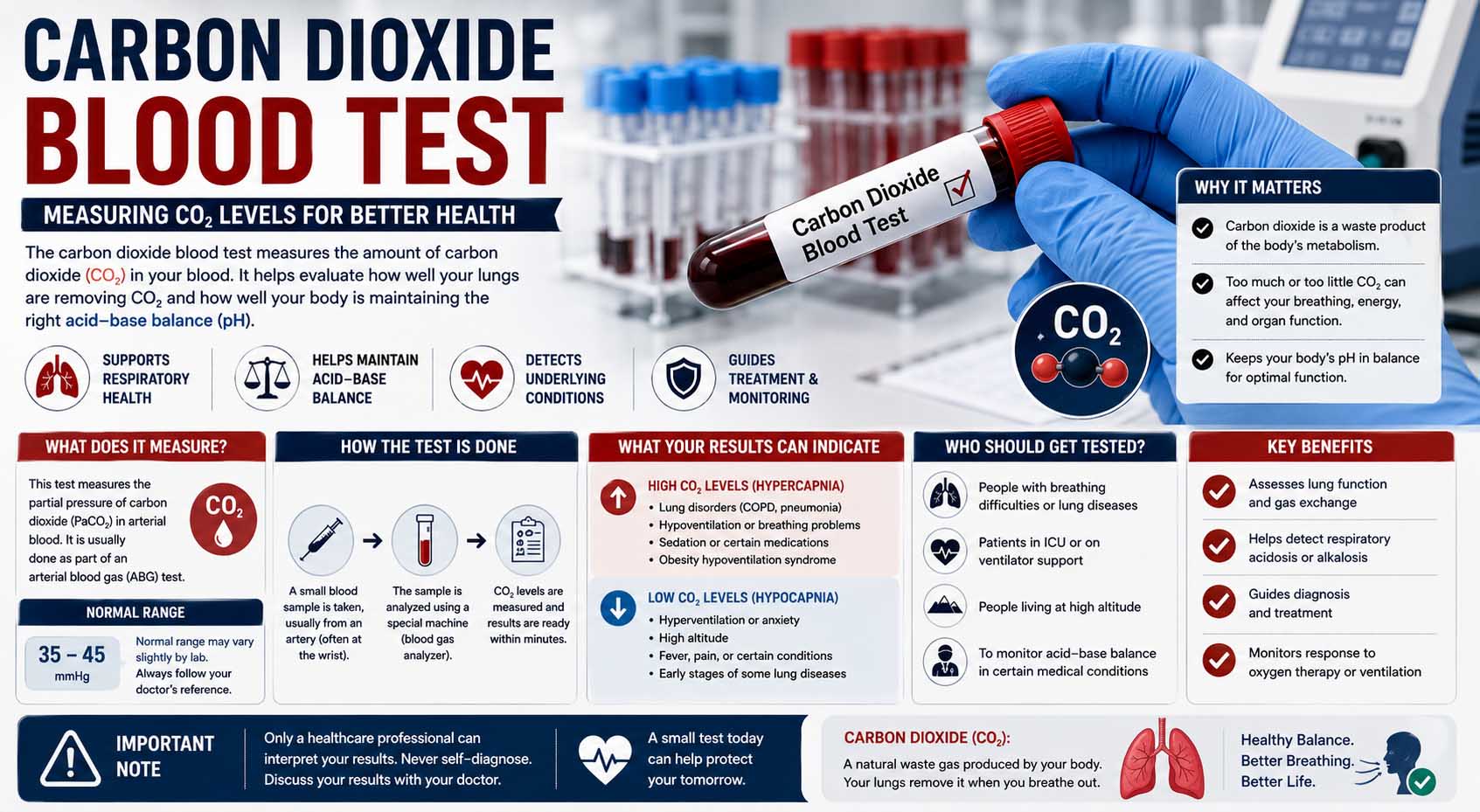
A carbon dioxide blood test measures the amount of carbon dioxide-related compounds in your blood and can provide useful clues about your body’s acid-base balance. Although the name may sound like the test directly measures the gas you breathe out, a standard blood chemistry test mainly reflects bicarbonate, a form of carbon dioxide that helps keep blood pH within a healthy range. Doctors often review this result alongside electrolytes and other laboratory values to understand how well the kidneys, lungs, and metabolism are working.
Mild changes can occur for many reasons, including dehydration, medications, breathing problems, kidney conditions, vomiting, or diarrhea. Therefore, your healthcare professional usually interprets the number in the context of your symptoms, medical history, and other test results.
What Is Carbon Dioxide in a Blood Test?
If you have looked at a metabolic panel and wondered what is carbon dioxide in blood test results, the answer is usually bicarbonate, written chemically as HCO3−. Most carbon dioxide in the blood exists in this form rather than as dissolved CO2 gas.
Bicarbonate acts as an important buffer. In other words, it helps prevent the blood from becoming too acidic or too alkaline.
Your lungs and kidneys work together to maintain this balance. Your lungs remove carbon dioxide when you breathe out, while your kidneys regulate bicarbonate and acids. Consequently, changes involving either organ system can sometimes affect the CO2 value on a blood chemistry panel.
A CO2 measurement is commonly included in a basic metabolic panel (BMP) or comprehensive metabolic panel (CMP). Therefore, you may receive a result even when your doctor did not order a separate test specifically for carbon dioxide.
Other laboratory measurements can provide different information about health. For example, an nrbc blood test evaluates nucleated red blood cells rather than acid-base balance, so doctors interpret it for a different clinical purpose.
Why Is a Carbon Dioxide Blood Test Ordered?
Healthcare professionals may check CO2 as part of routine blood work or while investigating certain symptoms and medical conditions.
For instance, the test may help assess electrolyte and acid-base balance. Doctors may also use it when evaluating kidney disease, metabolic disorders, breathing problems, severe dehydration, or unexplained changes in health.
Because CO2 is often included in a metabolic panel, the result is rarely considered alone. Sodium, potassium, chloride, creatinine, glucose, and other measurements can provide valuable context.
Your doctor might pay closer attention to the result if you have symptoms such as persistent weakness, unusual fatigue, vomiting, diarrhea, confusion, or breathing changes. However, these symptoms are nonspecific and can occur with many unrelated conditions.
Carbon Dioxide Blood Test Normal Range
Laboratory reference ranges vary slightly. A commonly used adult serum bicarbonate or total CO2 range is roughly 22 to 29 milliequivalents per liter (mEq/L), although some laboratories use different limits.
Therefore, always compare your result with the reference interval printed on your own laboratory report.
| CO2 result | General interpretation | Possible next step |
|---|---|---|
| Within the laboratory range | Acid-base balance may be normal | Interpret with other test results |
| Below the reference range | May reflect reduced bicarbonate | Review symptoms, medications, and other labs |
| Above the reference range | May reflect increased bicarbonate | Consider breathing, metabolic, and medication-related factors |
A result outside the reference range is not a diagnosis. Instead, it tells your healthcare professional that the finding may need to be interpreted alongside other information.
What Does a Low Carbon Dioxide Blood Test Mean?
A low carbon dioxide blood test generally means that the amount of bicarbonate measured in the blood is below the laboratory’s expected range.
Several processes can cause this pattern. For example, the body may lose bicarbonate, produce or retain too much acid, or compensate for changes in breathing.
Possible causes include prolonged or severe diarrhea, certain kidney problems, diabetic ketoacidosis, other forms of metabolic acidosis, and some medications. Rapid breathing can also alter acid-base balance, although the exact laboratory pattern depends on the underlying condition and whether it is acute or chronic.
Because several conditions can produce similar results, a carbon dioxide blood test low result should not be used for self-diagnosis.
Symptoms That May Occur With Low CO2
Some people with mildly reduced bicarbonate have no noticeable symptoms. In fact, the abnormality may first appear during routine laboratory testing.
When an underlying acid-base problem becomes more significant, symptoms can include weakness, fatigue, nausea, vomiting, confusion, or changes in breathing.
Meanwhile, breathing symptoms deserve separate attention because many respiratory conditions can cause them. People experiencing recurring noisy breathing may also want to understand how to stop wheezing, although new or severe wheezing should be medically assessed rather than treated based only on home advice.
High Carbon Dioxide in Blood Test Results
A high carbon dioxide in blood test result usually indicates that bicarbonate or total CO2 is above the laboratory reference range. Again, this measurement is different from directly measuring the partial pressure of carbon dioxide in arterial blood.
Higher bicarbonate can occur with metabolic alkalosis. For example, prolonged vomiting may cause the body to lose stomach acid, which can raise bicarbonate levels. Certain diuretics and other medications may also contribute.
Meanwhile, some people with long-standing respiratory conditions retain more carbon dioxide. Their kidneys may compensate over time by retaining bicarbonate, which can increase the total CO2 measurement on a metabolic panel.
Therefore, the clinical context matters greatly.
Possible Symptoms of an Abnormal High Level
A mildly elevated result may cause no symptoms by itself. Instead, symptoms usually come from the condition responsible for the change.
Depending on the cause, a person might experience weakness, muscle cramps, confusion, headache, abnormal breathing, or other symptoms.
Severe breathing difficulty, bluish or gray lips or skin, sudden confusion, fainting, or extreme drowsiness can signal a medical emergency. In those situations, seek urgent medical care rather than waiting for routine laboratory follow-up.
CO2 Blood Test vs. Arterial Blood Gas
People sometimes assume every CO2 test measures exactly the same thing. However, a routine metabolic panel and an arterial blood gas provide different information.
A standard chemistry panel primarily measures total carbon dioxide, most of which represents bicarbonate. In contrast, an arterial blood gas, or ABG, directly measures blood pH and the partial pressure of carbon dioxide (PaCO2) and oxygen (PaO2), while also providing or calculating bicarbonate.
Therefore, an ABG can give doctors a more detailed picture of ventilation and acid-base status. It is often used in hospitals and emergency settings when a person has significant respiratory or metabolic problems.
For example, clinicians treating serious oxygen problems may also document diagnoses such as acute hypoxic respiratory failure icd 10 when the patient’s clinical findings meet the appropriate criteria. However, a routine abnormal CO2 result by itself does not establish respiratory failure.
How Doctors Interpret an Abnormal Carbon Dioxide Blood Test
Doctors rarely look at CO2 in isolation. Instead, they examine patterns across several laboratory measurements.
Chloride is particularly useful because it changes in several acid-base disorders. Sodium and potassium can also provide clues, while kidney markers such as creatinine help show whether impaired kidney function may be involved.
In some cases, clinicians calculate the anion gap from electrolyte results. This calculation can help categorize certain forms of metabolic acidosis and guide further investigation.
Likewise, other blood tests may be ordered when the symptoms suggest unrelated blood or nutritional issues. For example, tibc blood test high results can occur during an evaluation of iron status and are interpreted with measurements such as serum iron, transferrin saturation, and ferritin.
Your Medical History Matters
Laboratory numbers become much more useful when combined with medical history.
For instance, your doctor may ask about recent vomiting or diarrhea, diabetes, kidney disease, lung conditions, supplements, and prescription medications. They may also ask whether you have experienced changes in breathing.
As a result, two people with the same CO2 number can require very different evaluations.
What Happens During the Test?
The procedure is straightforward because the CO2 measurement usually comes from a standard blood sample.
First, a healthcare professional cleans the skin, usually near a vein in your arm. Next, they insert a small needle and collect blood into one or more tubes. Afterward, they remove the needle and apply pressure to the area.
The entire blood draw usually takes only a few minutes.
You may feel a brief sting, while minor bruising or soreness can occur afterward. Serious complications from a routine blood draw are uncommon.
Fasting is not always required specifically for CO2 testing. However, your healthcare provider may request fasting when other tests are being performed at the same time. Therefore, follow the instructions given for your particular laboratory order.
Can You Improve an Abnormal CO2 Level at Home?
There is no single home treatment for an abnormal CO2 result because treatment depends on the cause.
For example, replacing fluids may be appropriate when mild dehydration is contributing to an electrolyte disturbance. However, significant acid-base disorders may require medical treatment rather than dietary or lifestyle changes.
Do not start bicarbonate supplements or make major changes to medications simply because your CO2 result is outside the reference range. Sodium bicarbonate can affect fluid balance, sodium levels, and acid-base chemistry, so it is not an appropriate self-treatment for every low result.
Likewise, people with chronic lung or kidney conditions should follow the treatment plan provided by their healthcare team.
When Might More Testing Be Needed?
A healthcare professional may repeat the metabolic panel if the abnormality is mild, unexpected, or inconsistent with your overall health.
Meanwhile, further testing may be appropriate when the result is significantly abnormal or symptoms suggest a more serious problem. Depending on the situation, testing could include kidney function measurements, glucose or ketones, additional electrolytes, an arterial or venous blood gas, or other investigations.
A complete blood count may also be ordered for separate clinical questions. For instance, mpv blood test high findings relate to platelet size and need to be interpreted alongside platelet counts and the broader clinical picture rather than the CO2 result itself.
Common Misunderstandings About CO2 Blood Results
One common misconception is that a high CO2 result means you simply have too much carbon dioxide gas trapped in your blood. On a routine metabolic panel, however, the measurement largely represents bicarbonate.
Another misconception is that one abnormal result proves you have lung disease. In reality, gastrointestinal problems, kidney function, metabolic changes, medications, and respiratory conditions can all influence acid-base balance.
Likewise, drinking more water cannot correct every abnormal value. Hydration may help when fluid loss contributes to the problem, but it cannot treat every kidney, metabolic, or respiratory disorder.
Finally, being one point outside the reference interval does not automatically signal a dangerous condition. Reference ranges help clinicians interpret results, but they do not replace individualized medical assessment.
Frequently Asked Questions
Is carbon dioxide in a blood test the same as the CO2 I breathe out?
They are related, but the measurements are not the same. A routine chemistry test mainly reflects bicarbonate in the blood. Meanwhile, an arterial blood gas can directly measure the partial pressure of dissolved carbon dioxide.
Is a low CO2 blood result dangerous?
It depends on how low the level is, why it is low, your other laboratory results, and whether you have symptoms. A mildly abnormal result may simply need follow-up, whereas a major acid-base disturbance can require prompt treatment.
Does high CO2 always mean a lung problem?
No. Elevated bicarbonate can result from several conditions, including metabolic alkalosis and compensation for some chronic respiratory disorders. Therefore, doctors consider the complete clinical picture.
Can dehydration affect CO2 levels?
Fluid and electrolyte disturbances can influence laboratory values and acid-base balance. However, dehydration does not explain every abnormal CO2 result, so persistent abnormalities should be discussed with a healthcare professional.
Should I worry about one abnormal carbon dioxide result?
Not necessarily. Small abnormalities sometimes occur temporarily or need confirmation. Still, you should review an unexpected result with the healthcare professional who ordered the test, especially when other laboratory measurements are abnormal or you feel unwell.
Practical Next Steps After Getting Your Results
Start by checking the reference range printed beside your CO2 result because laboratories do not all use identical ranges. Then, review the rest of your metabolic panel rather than focusing on one number.
Also, consider whether you recently had vomiting, diarrhea, dehydration, medication changes, or significant breathing symptoms, since those details may help your healthcare professional interpret the result.
Most of all, avoid trying to correct an abnormal carbon dioxide blood test with supplements or drastic dietary changes without knowing the cause. A mildly abnormal value may require nothing more than clinical review or repeat testing, while a substantial abnormality combined with concerning symptoms can need prompt medical evaluation.