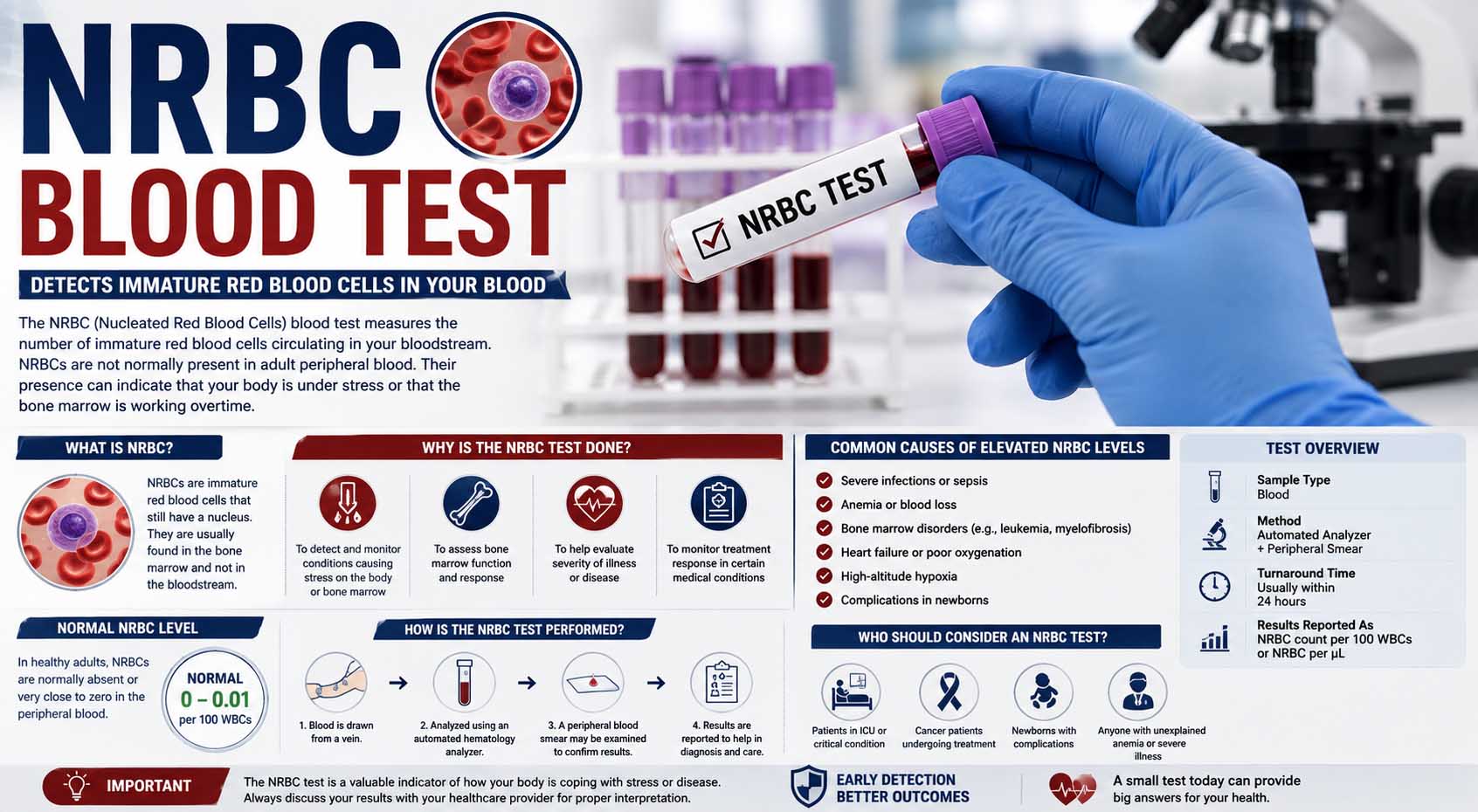
Seeing an unfamiliar abbreviation on a lab report can quickly raise questions. An NRBC blood test reports nucleated red blood cells, which are immature red blood cells that still contain a nucleus. They normally develop inside bone marrow before maturing and entering circulation. Therefore, finding NRBCs in an adult’s peripheral blood may prompt a healthcare professional to look at the result alongside the rest of the complete blood count (CBC), symptoms, medical history, and other tests.
A result of zero is common in healthy adults. However, NRBCs can normally appear in newborns, particularly shortly after birth. In adults, detectable levels can occur when the bone marrow is under significant stress or when certain illnesses affect blood cell production or oxygen delivery.
Still, an NRBC result alone cannot diagnose a condition. Instead, it provides one piece of information that must be interpreted in context.
What Is NRBC in Blood Test Results?
If you are wondering what is NRBC in blood test reports, NRBC stands for “nucleated red blood cell.” These cells are early forms of red blood cells, also called erythrocytes.
Mature red blood cells do not have nuclei. Instead, their structure allows them to carry hemoglobin efficiently, which helps transport oxygen from the lungs to tissues throughout the body.
NRBCs usually remain in bone marrow while they mature. Therefore, they are generally absent from peripheral blood in healthy older children and adults.
Modern automated blood analyzers can detect and count these immature cells during a CBC with differential. Depending on the laboratory, the result may appear as an absolute number, a percentage, or both.
Other CBC values also provide useful context. For example, platelet measurements can include mean platelet volume, so someone reviewing several flagged CBC results may also encounter a result such as mpv blood test high on the same or a related report.
Understanding Your NRBC Blood Test Result
Laboratories may report NRBCs differently. Consequently, you should always use the reference interval printed on your own laboratory report instead of comparing your number with a random online range.
Common reporting formats include:
| Result | General Meaning |
|---|---|
| NRBC 0 | No nucleated red blood cells detected |
| NRBC percentage | Number of NRBCs relative to another blood-cell count, depending on reporting method |
| Absolute NRBC | Measured concentration of NRBCs in the blood |
| Detectable/elevated NRBC | Requires interpretation with age, CBC findings and clinical circumstances |
Reference ranges and units vary between laboratories. In addition, newborn values are interpreted very differently from adult values.
What Does NRBC Blood Test 0 Mean?
An NRBC blood test 0 generally means the analyzer did not detect nucleated red blood cells in the blood sample. For a healthy adult, this is typically an expected finding.
Therefore, a zero NRBC result usually does not require treatment by itself.
However, the rest of the CBC still matters. A normal NRBC result does not automatically mean every aspect of the blood count is normal.
Hemoglobin, hematocrit, red blood cell count, white blood cell count, platelet count, and red cell indices may each provide separate information.
What Does NRBC Blood Test High Mean?
An NRBC blood test high result means nucleated red blood cells were detected above the laboratory’s expected reference level.
In an adult, this finding may suggest that the bone marrow is releasing immature red cells into circulation. That can happen when the body experiences significant physiological stress or when red blood cell production becomes unusually active or disrupted.
However, “high” does not point to one specific disease. Instead, several very different medical situations can produce NRBCs.
For this reason, healthcare professionals interpret the result alongside symptoms, physical findings, medical history, and other laboratory values.
A small elevation and a substantial elevation may also have different clinical significance. Therefore, avoid trying to judge severity based only on whether the result carries a high flag.
Possible Causes of Elevated NRBCs
Several processes may contribute to nucleated red blood cells appearing in peripheral blood.
Severe Anemia or Increased Red Cell Demand
When the body needs to replace red blood cells rapidly, bone marrow activity can increase. In some situations, immature cells may then enter circulation.
This can occur with certain forms of severe anemia, significant blood loss, or increased destruction of red blood cells.
Doctors may order iron-related studies when investigating anemia. For instance, a tibc blood test high result can sometimes occur with iron deficiency, although TIBC and NRBCs measure very different aspects of blood health.
Low Oxygen Levels
Severe or prolonged lack of adequate oxygen can stimulate increased red blood cell production. Consequently, NRBCs may sometimes appear when serious heart or lung conditions interfere with oxygen delivery.
However, NRBCs do not measure blood oxygen directly. Therefore, doctors use clinical assessment and other tests to determine whether low oxygen is involved.
Bone Marrow Disorders
Some disorders affecting bone marrow can disrupt normal blood-cell development and release immature cells into circulation.
These conditions cannot be diagnosed from an NRBC result alone. Instead, abnormal white blood cells, platelet changes, anemia, symptoms, and sometimes specialized testing help determine whether further investigation is needed.
Severe Illness and Physiological Stress
NRBCs can sometimes appear in critically ill patients, including people experiencing severe infections, major inflammation, significant blood loss, or other serious physiological stress.
In these situations, the result is interpreted as part of the broader clinical picture rather than as an isolated diagnosis.
Spleen-Related Conditions
The spleen helps filter abnormal or aging blood cells from circulation. Therefore, changes in splenic function or absence of the spleen may affect which immature or abnormal cells remain visible in peripheral blood.
Again, this possibility requires clinical interpretation rather than self-diagnosis from a laboratory report.
What Is an NRBC Absolute Blood Test?
The NRBC absolute blood test reports the actual concentration of nucleated red blood cells detected in a specific volume of blood.
Meanwhile, another laboratory may report NRBCs as a relative value. Because reporting methods and units differ, two numbers from different laboratories may not be directly comparable.
For example, an absolute result can help clinicians understand how many NRBCs are circulating rather than relying solely on a percentage.
Still, the number does not provide a diagnosis by itself. A healthcare professional will usually compare it with hemoglobin, hematocrit, white blood cells, platelets, and other CBC measurements.
Trends can also matter. If multiple blood tests have been performed, the clinician may compare current and previous results to determine whether an abnormality is new, stable, increasing, or resolving.
How Doctors Evaluate an Abnormal NRBC Blood Test
An abnormal NRBC finding is usually evaluated as part of a larger medical picture.
First, a clinician may review the full CBC. Hemoglobin and hematocrit can help identify anemia, while white blood cell and platelet results may reveal other abnormalities.
Next, the doctor may consider symptoms and recent health events. Fatigue, unusual bleeding, fever, shortness of breath, recent surgery, major illness, or other symptoms may influence which tests are appropriate.
A physical examination can provide useful clues as well. In some settings, a structured head to toe assessment helps healthcare professionals evaluate the whole patient rather than focusing only on a single laboratory number.
Depending on the findings, further testing might include a repeat CBC, peripheral blood smear, reticulocyte count, iron studies, vitamin testing, hemolysis-related tests, or other investigations.
More specialized testing may be considered when the overall blood picture suggests a bone marrow or hematologic disorder.
NRBC Results in Babies and Children
NRBC interpretation depends strongly on age.
Newborn babies can normally have nucleated red blood cells circulating shortly after birth because blood formation and oxygen conditions around delivery differ from those of adults. Consequently, the presence of NRBCs in a newborn does not carry the same meaning as it does in an adult.
Levels generally decrease after birth. However, clinicians may pay closer attention when values are unexpectedly high or persist longer than anticipated, especially when other clinical concerns are present.
In older children, interpretation depends on age, health status, laboratory reference ranges, and associated blood findings.
Therefore, parents should discuss pediatric NRBC results with the child’s healthcare professional rather than using adult reference information.
Can Liver Tests Help Explain an Abnormal Blood Count?
Sometimes clinicians order several laboratory panels at once because blood abnormalities can occur alongside problems involving other organs.
For example, AST is an enzyme that can increase with liver injury but is also found in other tissues. Therefore, someone who receives several abnormal laboratory results may separately wonder what level of ast is dangerous.
However, AST and NRBC measurements answer different clinical questions. One abnormal value should not automatically be assumed to explain another.
Instead, clinicians interpret patterns across the complete set of laboratory results.
Symptoms Associated With Conditions That Cause NRBCs
NRBCs themselves do not usually cause noticeable symptoms. Instead, symptoms come from the underlying condition responsible for their appearance.
Depending on the cause, a person might experience fatigue, weakness, dizziness, shortness of breath, pale skin, rapid heartbeat, fever, or other symptoms.
However, these symptoms are nonspecific. Many common and minor conditions can cause fatigue or dizziness, while some people with abnormal blood tests may have few obvious symptoms.
Therefore, symptoms should guide medical evaluation rather than being used to diagnose the reason for an NRBC elevation at home.
Does a High NRBC Result Need Treatment?
There is no general treatment designed simply to lower NRBCs.
Instead, treatment targets the underlying cause. For example, management would differ greatly between iron deficiency, blood loss, a serious infection, a hemolytic condition, and a bone marrow disorder.
As the underlying problem improves, NRBC levels may also change.
For that reason, supplements should not be started solely because NRBCs appear on a report. Iron, vitamin B12, folate, and other supplements are useful in specific deficiencies, but taking them without knowing the cause may be unnecessary and could complicate care.
When Should You Talk to a Healthcare Professional?
If an adult blood test unexpectedly shows NRBCs, discussing the result with the clinician who ordered the test is sensible, particularly when other CBC values are abnormal.
Seek prompt medical care if concerning symptoms accompany abnormal results, such as significant difficulty breathing, chest pain, fainting, severe weakness, confusion, uncontrolled bleeding, or another rapidly worsening symptom.
For a non-urgent abnormal result, prepare for your appointment by bringing previous laboratory reports and a current medication or supplement list. That information can make it easier to identify changes over time.
Common Questions About the NRBC Blood Test
Is NRBC 0 normal?
For healthy adults, an NRBC value of zero is commonly expected. However, reference ranges and reporting methods vary, so the laboratory’s own reference interval should guide interpretation.
Are NRBCs always a sign of cancer?
No. NRBCs can appear for several reasons, including severe anemia, major physiological stress, low oxygen states, blood loss, hemolysis, and some bone marrow conditions. Therefore, their presence does not automatically mean cancer.
Can dehydration cause a high NRBC result?
Dehydration can affect the concentration of some blood measurements, but an NRBC elevation should not simply be assumed to result from dehydration. A clinician should interpret detectable NRBCs in the context of the complete blood count and health status.
Can stress increase NRBCs?
Everyday emotional stress is not generally what clinicians mean when they associate NRBCs with “stress.” Instead, the term often refers to substantial physiological stress caused by serious illness, low oxygen, blood loss, or other significant medical conditions.
Should an abnormal NRBC test be repeated?
Sometimes a clinician may repeat a CBC to confirm or monitor an abnormal result. However, whether repeat testing is needed depends on the NRBC level, other blood values, symptoms, age, and medical history.
What to Take Away From Your Result
An NRBC blood test measures immature red blood cells that still contain a nucleus. In healthy adults, these cells are usually absent from peripheral blood, so a result of zero is generally expected. Meanwhile, newborns can normally have detectable NRBCs for a period after birth.
If NRBCs are elevated in an adult, the finding does not identify a specific disease on its own. Instead, doctors consider the complete CBC, symptoms, medical history, examination findings, and sometimes follow-up tests to understand why immature red cells have entered circulation.
Rather than trying to interpret one flagged number in isolation, review the entire report with a qualified healthcare professional. That approach provides a much clearer picture of whether the result is expected, needs monitoring, or requires further evaluation.