Aching along the front or inner side of your lower leg after running or exercise can be one of the most recognizable shin splints symptoms. The discomfort often starts during or after physical activity and may initially improve with rest. However, continuing the same high-impact routine without enough recovery can make the pain more persistent. Although shin splints are common among runners, dancers, military recruits, and people starting new workouts, similar pain can also come from a stress fracture or another lower-leg problem.
It involves exercise-related pain along the tibia, or shinbone, and surrounding tissues. Fortunately, many cases improve with temporary activity changes and a gradual return to exercise. Still, persistent or highly localized pain deserves medical assessment.
Common Shin Splints Symptoms
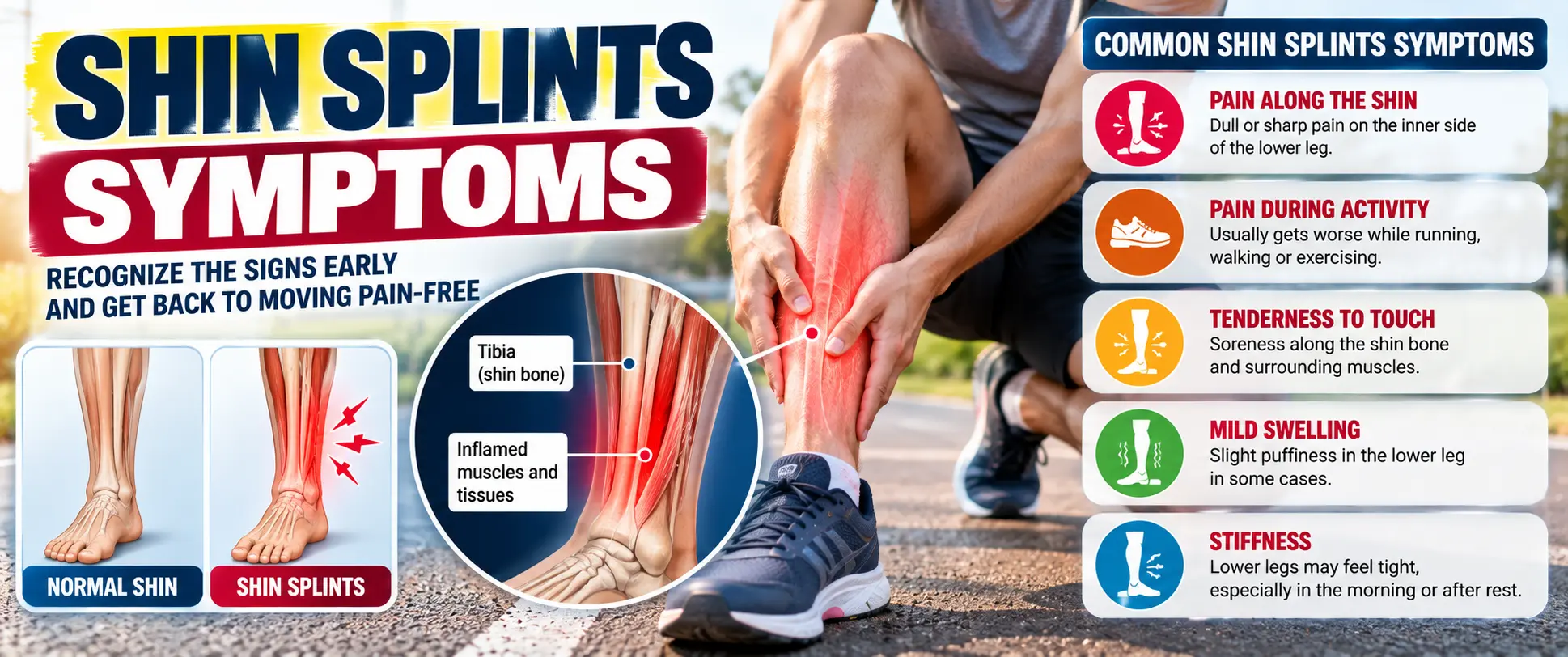
The classic symptom is pain or tenderness along the inner border of the shinbone. Rather than appearing at one tiny point, the soreness often extends across a broader area of the lower leg.
Common symptoms of shin splints can include:
- Aching or soreness along the inner or front portion of the shin
- Pain that develops during running, jumping, or other repetitive impact
- Discomfort after exercise
- Mild swelling in some cases
- Pain that initially improves after stopping activity
Early on, you might notice discomfort only after a workout. However, as irritation progresses, pain may begin earlier during activity and take longer to settle afterward.
The location also matters. For example, pain centered around the ankle or foot may suggest another cause. Conditions associated with top of foot pain can produce discomfort close enough to the lower leg that people sometimes assume they have shin splints.
Signs and Symptoms of Shin Splints as They Progress
Shin splints do not always feel exactly the same from one person to another. Nevertheless, symptoms often follow a recognizable pattern.
Early Symptoms
At first, the shin may feel mildly sore after a run or a long period of exercise. Because the pain settles with rest, many people continue training normally.
Yet this is often the point when reducing impact and addressing training errors can be especially helpful.
Symptoms During Exercise
If the problem continues, pain may appear shortly after starting exercise. Sometimes the discomfort temporarily becomes less noticeable as the body warms up, which can tempt a person to keep running.
However, reduced pain during activity does not necessarily mean the irritated area has recovered.
More Persistent Symptoms
With continued repetitive loading, soreness may last after exercise or appear during ordinary daily activities. At that stage, taking a break from painful high-impact exercise and seeking professional guidance may be appropriate.
Pain that becomes sharply localized, severe, or present even at rest deserves particular attention because another injury may be responsible.
What Causes Shin Splints?
Shin splints usually develop when the lower leg experiences more repetitive stress than it can comfortably tolerate.
A sudden increase in running distance is a common trigger. Likewise, increasing speed, adding hill workouts, returning to sport after a long break, or starting a high-impact exercise program too aggressively can overload the lower legs.
Hard training surfaces may contribute in some people. Meanwhile, worn or poorly suited footwear can affect how forces move through the feet and legs.
Running mechanics, foot structure, muscle capacity, and previous injuries may also influence risk. Therefore, shin splints rarely come down to one universal cause.
Other foot problems can change movement patterns as well. For instance, a bone spur on top of foot can cause a different type of discomfort that may affect walking or exercise, so persistent foot and shin symptoms should not automatically be treated as the same condition.
Shin Splints vs Stress Fracture Symptoms
One of the most useful distinctions is shin splints vs stress fracture symptoms, since both can produce lower-leg pain after repetitive exercise.
| Feature | Shin Splints | Stress Fracture |
|---|---|---|
| Typical pain | Aching or soreness | Often sharper or more focal |
| Tender area | Usually spread along a broader section | Often concentrated at a smaller point |
| Activity relationship | Common during or after exercise | May progressively worsen with loading |
| Rest pain | Less typical early on | Can occur as injury progresses |
| Medical assessment | Helpful if persistent | Particularly important if suspected |
These differences are only general clues. Therefore, you should not use them to diagnose yourself.
A bone stress injury can become more serious if loading continues. Consequently, pain that is sharply focused over one point on the bone, worsening despite rest, affecting normal walking, or occurring at night should be assessed by a healthcare professional.
How Doctors Diagnose Shin Splints Symptoms
There is no single blood test that confirms shin splints. Instead, a healthcare professional usually starts by asking where the pain occurs, when it started, how your training changed, and which activities make it worse.
They may then examine the shin and assess tenderness, swelling, strength, walking, and lower-limb movement.
Imaging is not always necessary for a straightforward case. However, if a stress fracture or another condition is suspected, a clinician may consider imaging such as an X-ray or MRI depending on the circumstances.
Blood tests generally play little role in diagnosing typical shin splints. For comparison, a ck blood test measures creatine kinase and may be used when clinicians need information about muscle injury or certain muscle-related conditions; it is not a standard diagnostic test for uncomplicated shin splints.
Conditions That Can Feel Like Shin Splints
Not every exercise-related lower-leg pain is medial tibial stress syndrome. Therefore, paying attention to the exact location and character of the symptoms matters.
Stress fractures are an important alternative diagnosis. Meanwhile, chronic exertional compartment syndrome can cause exercise-related tightness, pain, or neurological symptoms that typically follow a different pattern.
For example, tarsal tunnel syndrome symptoms can include nerve-related discomfort affecting the ankle and foot rather than the typical broad shin tenderness associated with medial tibial stress syndrome.
Muscle strains, tendon problems, vascular conditions, and other injuries may also cause lower-leg discomfort. As a result, unusual symptoms or pain that fails to improve should not simply be labeled shin splints.
Shin Splints Symptoms, Causes, and Treatment
Treatment generally begins by reducing the activity that provokes pain. That does not always mean avoiding all movement. Instead, the goal is to reduce repetitive impact while allowing irritated tissues time to recover.
Temporarily Reduce Painful Impact
Running through worsening shin pain can delay recovery. Therefore, temporarily reduce running, jumping, or whichever activity triggers symptoms.
Depending on your symptoms and medical guidance, lower-impact activities such as swimming or cycling may help you maintain fitness while reducing repetitive impact on the shin.
Use Cold for Short-Term Comfort
Applying a wrapped cold pack for a short period after activity may help with temporary pain relief. However, ice does not correct the training or biomechanical factors that contributed to the problem.
Never place ice directly on bare skin, and stop if the area becomes painfully numb.
Review Your Training Routine
Think about what changed shortly before symptoms started. Perhaps you increased weekly mileage, added hills, changed running surfaces, started sprinting, or returned to exercise after several inactive weeks.
Once symptoms settle, increase training gradually rather than immediately returning to the workload that triggered the problem.
Check Your Footwear
Running shoes do not prevent every injury. Still, footwear that is comfortable, appropriate for the activity, and not excessively worn may help you manage training more effectively.
If you repeatedly develop shin pain, a physical therapist, sports medicine professional, or qualified footwear specialist may help identify contributing factors.
How Long Do Shin Splints Take to Heal?
Recovery time varies. Mild symptoms may improve relatively quickly after the provoking activity is reduced, whereas more persistent cases can require several weeks or longer.
Rather than using a fixed calendar date, pay attention to symptoms and function.
You should generally be able to perform ordinary daily activities comfortably before progressing toward harder impact exercise. Then, when you return to running, start below your previous training volume and increase gradually.
If pain returns, reduce the workload rather than pushing through it.
Can You Exercise With Shin Splints?
Exercise choices depend on symptom severity. Continuing an activity that clearly reproduces pain is usually not a good recovery strategy.
However, complete inactivity may not always be necessary. If appropriate for you, low-impact cardiovascular exercise can sometimes maintain conditioning while the shin settles.
Jumping exercises require particular care because they place repetitive loads through the lower legs. Although there are cardiovascular and coordination benefits of jumping rope, it is sensible to pause or modify rope jumping when it triggers shin pain and resume gradually once symptoms have settled.
A healthcare or rehabilitation professional can provide more personalized guidance when symptoms are persistent or you are unsure which activities are safe.
How to Help Prevent Shin Splints
No prevention strategy works perfectly. Nevertheless, sensible training habits can reduce unnecessary overload.
Increase running distance and intensity gradually, especially after time away from exercise. Similarly, avoid changing several training variables at once. Adding speed work, hills, and substantially more mileage in the same week can make it difficult for your body to adapt.
Strength and conditioning can also support a balanced exercise program. Depending on your needs, exercises targeting the calf, foot, hip, and surrounding muscles may form part of a rehabilitation or prevention plan.
Meanwhile, adequate recovery matters. Sleep, rest days, and sufficient nutrition support normal adaptation to training, although none serves as a guaranteed cure for shin splints.
Most of all, respond to recurring pain rather than repeatedly training through it.
When Should You See a Doctor?
Mild exercise-related shin soreness that improves after reducing activity may not require urgent medical attention. However, certain symptoms deserve evaluation.
Seek medical advice if the pain is severe, keeps worsening, remains despite appropriate rest, repeatedly returns when you resume exercise, or interferes with normal walking.
Likewise, get assessed if the pain is concentrated in one small area over the bone, since that pattern can raise concern for a bone stress injury.
Sudden severe swelling, redness, unusual warmth, significant weakness, persistent numbness, a cold or pale foot, or symptoms after a major injury also warrant prompt assessment.
If you cannot comfortably bear weight or symptoms are severe and rapidly worsening, seek timely medical care.
Common Questions About Shin Splints
Where do shin splints usually hurt?
The painful region is generally broader than the small, highly localized tender spot that may occur with some stress fractures.
What do early shin splints symptoms feel like?
Early shin splints symptoms often feel like a dull ache or tenderness that develops during or after running or another repetitive-impact activity. Initially, the discomfort may improve fairly quickly with rest.
Can shin splints cause swelling?
Mild swelling can occur, although it is not always present. Significant swelling, redness, or rapidly worsening symptoms should prompt consideration of other causes and may require medical evaluation.
Can shin splints hurt when walking?
They can, particularly when symptoms have become more persistent. However, pain during ordinary walking may also indicate a more significant injury, so persistent or worsening symptoms deserve assessment.
Should I massage shin splints?
Gentle soft-tissue work around tight muscles may feel comfortable for some people, but aggressively massaging a painful shinbone is not a substitute for diagnosis or load management. If a stress fracture is possible, seek professional assessment instead of repeatedly manipulating the painful area.
Do shin splints go away on their own?
Many cases improve when the provoking activity is reduced and training errors are corrected. However, symptoms may return if you resume high-impact exercise too quickly or fail to address contributing factors.
A Safer Way Back to Running and Exercise
The main signs and symptoms of shin splints are activity-related aching and tenderness along a broader area of the shin. While the condition often improves with reduced impact and a gradual return to exercise, lower-leg pain should not automatically be assumed to be shin splints.
Pay particular attention to pain that becomes sharply localized, occurs at rest, interferes with walking, or continues despite reducing activity. Those features can justify medical assessment to rule out a stress fracture or another problem.
Once symptoms settle, rebuild your training progressively. Small increases in distance and intensity, suitable footwear, adequate recovery, and attention to recurring pain can make the return to exercise much smoother.