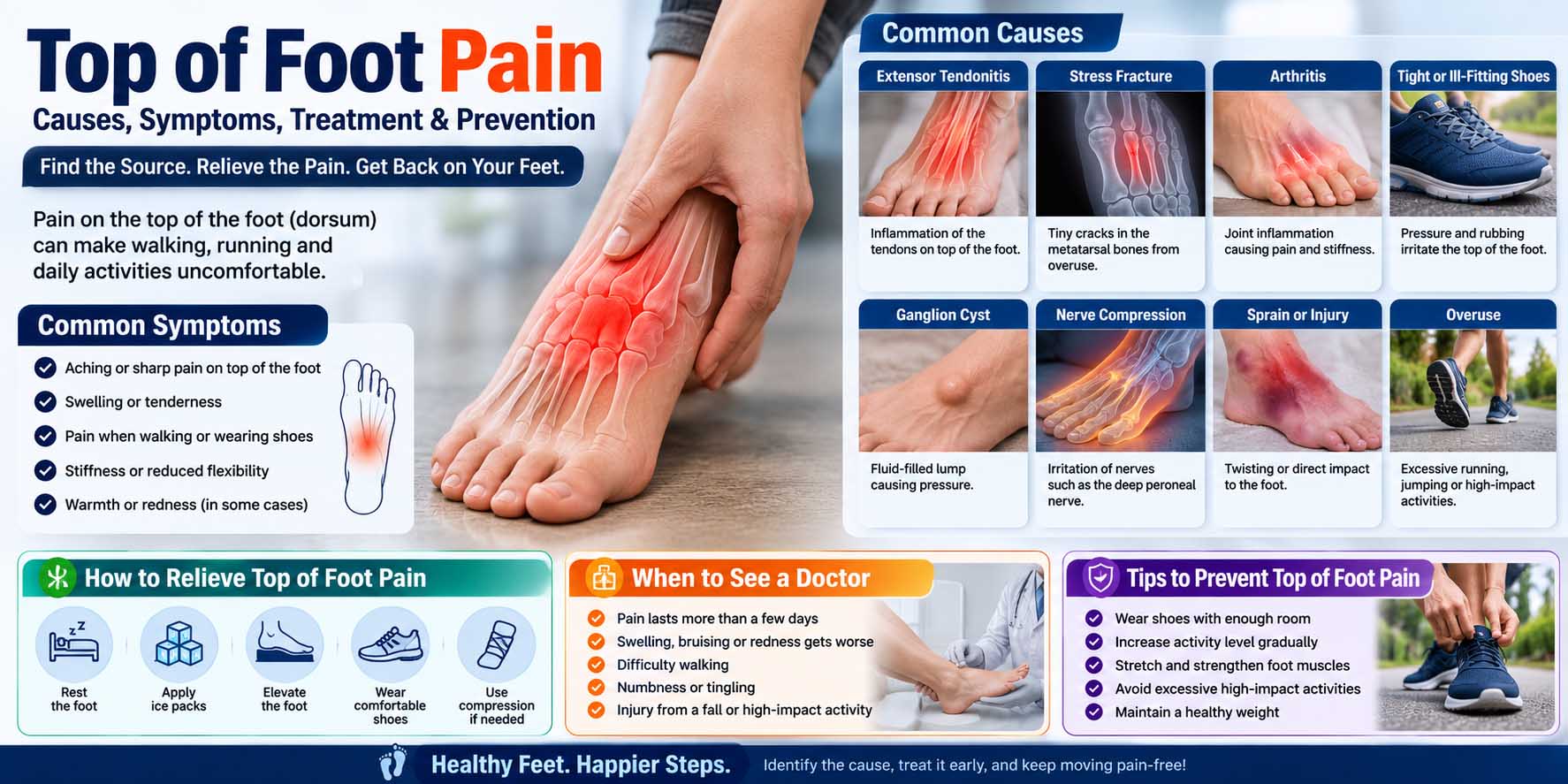
Top of foot pain can come from overuse, tight shoes, tendon irritation, arthritis, a stress injury, or, less commonly, a nerve or bone problem. Because the top of the foot contains small joints, tendons, nerves, and bones packed into a relatively small area, even minor irritation can become noticeable when you walk. However, persistent, severe, or worsening pain deserves medical evaluation rather than treatment as simple soreness.
For many people, the discomfort develops after increased walking, running, exercise, or a change in footwear. Meanwhile, others notice swelling, tenderness, burning, or pain with specific movements. Therefore, the exact pattern of symptoms can help narrow the likely cause.
Where Pain on Top of Foot Usually Comes From
The top of the foot includes the metatarsal bones, small joints, extensor tendons, nerves, and soft tissues. As a result, several structures can produce similar symptoms.
Some people feel discomfort near the ankle, while others notice pain across the middle of the foot or closer to the toes. Likewise, the pain may feel sharp, aching, burning, or tender to touch.
Common clues include:
- pain during walking or running
- tenderness when pressing the area
- swelling
- pain when lifting the toes
- discomfort from shoes or laces
- stiffness after rest
- numbness or tingling
Because these symptoms overlap, the location alone does not always identify the cause.
Common Causes of Top of Foot Pain
Several conditions can cause discomfort across the upper surface of the foot. Some are temporary and improve with reduced activity, while others require medical treatment.
Extensor Tendon Irritation
Extensor tendons run across the top of the foot and help lift the toes. Therefore, overuse or pressure from footwear can irritate them.
This type of pain may become worse when you walk uphill, run, climb stairs, or lift your toes. Tight shoelaces can also place pressure over the tendons and make the area sore.
People who recently increased their training distance or changed shoes may have a higher risk of this problem.
If symptoms are mild, reducing the aggravating activity and loosening footwear may help. However, ongoing tenderness or swelling deserves assessment.
Stress Fracture
A stress fracture is a small crack that develops from repeated loading rather than one major injury. It often affects the metatarsal bones in runners, dancers, hikers, military recruits, and people who suddenly increase physical activity.
Pain commonly starts gradually. At first, it may appear only during exercise. Later, it can persist during normal walking or even at rest.
Localized tenderness over one small spot is another common clue.
Because continuing high-impact activity can worsen a stress fracture, persistent pain on top of foot after increased exercise deserves medical attention. The American Academy of Orthopaedic Surgeons’ guidance on stress fractures of the foot and ankle explains common symptoms, risk factors, diagnosis, and treatment.
Tight Shoes and Lacing Pressure
Sometimes, footwear is the simplest explanation.
Shoes that fit too tightly across the top can compress tendons, nerves, and soft tissues. Similarly, overly tight laces can create pressure over the midfoot.
This problem becomes more likely if the pain improves after removing the shoes.
However, repeated footwear pressure deserves attention because it can worsen existing irritation or inflammation.
Bone Spur on Top of Foot and Arthritis
A bone spur on top of foot can develop around a joint, especially when arthritis has affected the midfoot over time.
A bone spur is an extra growth of bone. It does not always cause symptoms. However, it can rub against shoes or irritate nearby soft tissues.
People may notice:
- a firm bump on the top of the foot
- shoe pressure over the area
- stiffness
- aching during walking
- swelling around the joint
Midfoot arthritis can also cause pain that worsens with activity and improves with rest.
Treatment depends on severity. For some people, wider shoes, padding, activity changes, or orthotics may reduce pressure. In other cases, a healthcare professional may recommend imaging or specialist treatment.
Foot Pain on Top of Foot After Exercise
Exercise-related pain often points toward overuse, especially when no obvious injury occurred.
Running, jumping, hiking, or long periods of walking can irritate tendons and joints. Likewise, changing from a low-activity routine to intense exercise too quickly can overload the foot.
For example, a runner who suddenly doubles weekly mileage may develop foot pain on top of foot from tendon irritation or a stress injury.
Therefore, increase training gradually rather than making sudden jumps in distance or intensity.
Also, consider your shoes. Worn-out cushioning, poor fit, or pressure across the top of the foot may contribute to symptoms.
If pain changes your walking pattern or keeps returning after exercise, reduce the activity and seek an evaluation.
Nerve-Related Pain in Top of Foot
Nerve irritation can cause burning, tingling, numbness, or electric-like pain.
Sometimes, pressure from tight footwear irritates a superficial nerve. In other cases, the problem may originate higher in the leg or involve an underlying neurological condition.
For example, tarsal tunnel syndrome symptoms usually affect the inner ankle and bottom of the foot because compression affects the tibial nerve in that area. However, nerve-related foot symptoms can vary depending on which nerve has a problem.
A healthcare professional may check sensation, reflexes, muscle strength, and the distribution of symptoms when signs suggest nerve involvement.
Could Charcot-Marie-Tooth Disease Cause Foot Pain?
Charcot-Marie-Tooth disease is an inherited neurological disorder that affects peripheral nerves. It can lead to muscle weakness, altered foot shape, balance problems, and sensory changes.
People researching charcot–marie–tooth disease symptoms may also come across foot pain because high arches, hammertoes, weakness, and pressure changes can make footwear and walking uncomfortable.
However, occasional top-of-foot soreness more commonly results from overuse, footwear, tendon irritation, or minor injury.
If foot symptoms occur with progressive weakness, noticeable changes in foot shape, frequent tripping, or a strong family history of nerve disease, medical evaluation is appropriate.
Other Possible Causes of Pain in Top of Foot
Although overuse injuries are common, other conditions can cause pain in top of foot as well.
Sprain or Direct Injury
A twist, fall, dropped object, or sports injury can damage ligaments, bones, or soft tissue.
Swelling and bruising may develop quickly. Meanwhile, putting weight on the foot can become difficult.
If the foot looks deformed, swelling is severe, or you cannot comfortably bear weight, seek medical attention.
Ganglion Cyst
A ganglion cyst is a fluid-filled lump that can form near a joint or tendon.
When one develops on the top of the foot, shoe pressure may make it uncomfortable. Some cysts remain painless, while others cause aching or irritation.
Do not try to puncture or drain a lump yourself. Instead, ask a healthcare professional to evaluate an unexplained foot mass.
Gout
Gout causes sudden joint inflammation from uric acid crystal buildup. Although it famously affects the big toe, other joints in the foot can also become involved.
A gout attack often causes intense pain, redness, warmth, and swelling.
Because infection can sometimes look similar, seek medical assessment for a first episode of a hot, swollen joint.
How Doctors Diagnose Top of Foot Pain
A healthcare professional will usually begin by asking when the pain started and what makes it better or worse.
They may also ask about:
- recent exercise changes
- injuries
- footwear
- swelling or bruising
- numbness or tingling
- previous foot problems
- medical conditions
- medications
During the examination, they may press different areas, watch you walk, check your range of motion, and test muscle strength.
If symptoms suggest a fracture, arthritis, or another structural problem, a clinician may order imaging.
X-rays can identify many bone problems, although they may not show an early stress fracture immediately. Therefore, a healthcare professional may consider MRI or other imaging if symptoms strongly suggest a stress injury.
When Top of Foot Pain Needs Medical Attention
Mild pain that clearly follows temporary overuse may improve with conservative care. Still, several warning signs deserve prompt evaluation.
Seek medical attention if you have:
- severe pain
- major swelling
- visible deformity
- inability to bear weight
- redness and warmth with fever
- numbness or weakness
- pain after a significant injury
- pain that keeps worsening
- persistent symptoms despite rest
People with diabetes, poor circulation, neuropathy, or immune problems should also take foot injuries seriously because these conditions can affect healing or increase complications.
Home Care for Mild Pain on Top of the Foot
When symptoms are mild and no major injury occurred, simple measures may help.
First, reduce activities that aggravate the pain. For example, temporarily switch from running to a lower-impact activity if you can still walk comfortably.
Next, check your footwear. Loosen the laces and avoid shoes that press on the painful area.
Cold packs may help reduce soreness and swelling after overuse. Wrap the pack in a cloth rather than placing ice directly on the skin, and use it for short periods.
Elevation can also help if you notice swelling.
However, medication choice depends on your health history, other medicines, kidney function, digestive history, and pregnancy status. Therefore, ask a pharmacist or healthcare professional if you are uncertain about which medication is appropriate.
How Long Does Recovery Take?
Recovery depends entirely on the cause.
Minor tendon irritation may improve over days to a few weeks once you reduce the aggravating activity. Meanwhile, stress fractures generally require a longer recovery period and a gradual return to activity.
Arthritis-related pain may fluctuate rather than disappear completely, so treatment usually focuses on reducing symptoms and improving function.
Nerve-related pain also varies based on the underlying cause.
Instead of returning to full activity as soon as the pain decreases, increase walking or exercise gradually. Otherwise, symptoms may quickly return.
Preventing Recurrent Foot Pain
You cannot prevent every cause, but several practical habits can reduce unnecessary stress on the foot.
Choose shoes that provide enough space across the top and do not compress the midfoot. Likewise, replace worn footwear when support or cushioning has noticeably broken down.
Increase exercise gradually rather than making sudden jumps in distance or intensity.
Warm up before demanding activity and allow recovery time between harder sessions.
If a particular lacing pattern causes pressure, try skipping the eyelets directly over the sensitive area. However, the shoe should still remain secure.
People with recurring pain may also benefit from a podiatry or physical therapy assessment to evaluate foot mechanics, strength, and footwear.
Frequently Asked Questions
Why Does the Top of My Foot Hurt Without an Injury?
Overuse, tight shoes, tendon irritation, arthritis, nerve irritation, and stress fractures can all develop without one obvious injury.
Can Tight Shoes Cause Top of Foot Pain?
Yes. Tight shoes and laces can place pressure on tendons, nerves, and joints. If pain improves when you remove the shoe, footwear may contribute to the problem.
Can You Walk on a Stress Fracture?
Some people can still walk with a stress fracture, especially early on. However, continued loading can worsen the injury. Therefore, seek an evaluation for localized pain that increases with activity.
Why Does the Top of My Foot Hurt When I Walk?
Possible causes include tendon irritation, arthritis, a stress injury, footwear pressure, or joint problems. The location and associated symptoms help narrow the cause.
Should I Massage Pain on Top of the Foot?
Gentle massage may feel comfortable for minor muscle or tendon soreness. However, avoid aggressive massage if you may have a fracture, acute injury, gout, or significant swelling.
When Should I See a Podiatrist?
Consider seeing a podiatrist or another qualified healthcare professional when pain persists, keeps returning, affects your walking, or occurs with numbness, swelling, or structural changes.
Practical Next Steps
If your top of foot pain started after a recent change in exercise or footwear, reduce the aggravating activity and check whether your shoes place pressure on the area. Meanwhile, monitor for swelling, bruising, numbness, or increasing tenderness.
However, do not keep exercising through persistent pain simply because you can still walk. Repeated activity can aggravate stress injuries, joint problems, and tendon conditions.
If the discomfort lasts, worsens, or changes the way you walk, a healthcare professional can help identify the cause and recommend treatment that matches the specific problem.