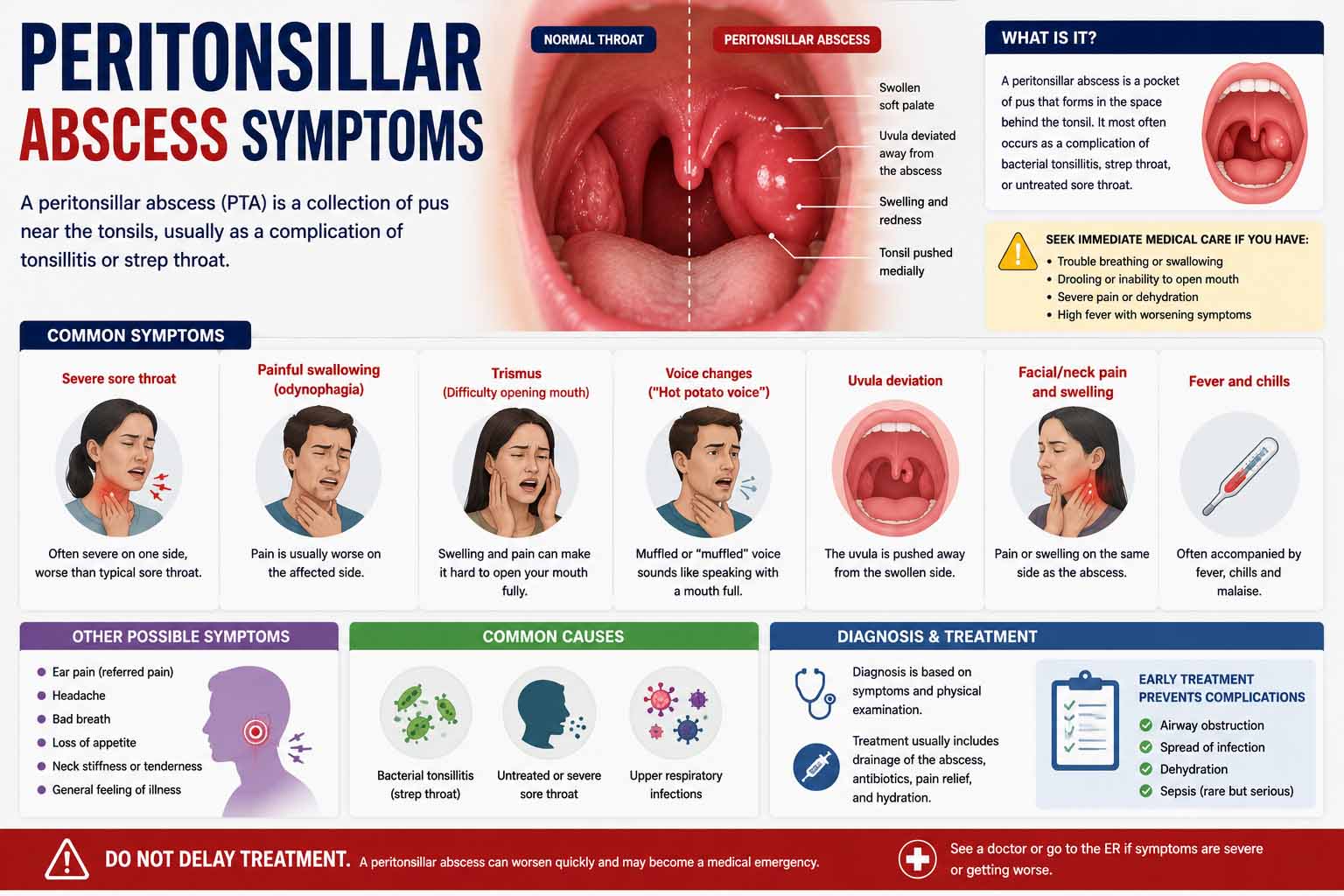
A severe sore throat does not always mean you have a routine throat infection. Peritonsillar abscess symptoms often include intense pain on one side of the throat, difficulty swallowing, fever, a muffled voice, and swelling around a tonsil. Because the infection can sometimes interfere with swallowing or breathing, recognizing these warning signs early can help you get appropriate medical care before complications develop.
A peritonsillar abscess is a pocket of pus that forms in the tissues next to a tonsil. It often develops as a complication of tonsillitis or another infection in the throat. Although antibiotics and drainage usually treat the condition successfully, a suspected abscess needs medical assessment rather than home treatment alone.
What Is a Peritonsillar Abscess?
A peritonsillar abscess forms when infection spreads beyond a tonsil into the nearby soft tissues. As pus collects, the affected area becomes increasingly swollen and painful.
The condition usually affects only one side. Therefore, a sore throat that becomes dramatically worse on one side can be a useful warning sign, especially when fever, trouble swallowing, or changes in the voice occur at the same time.
Because the mouth and throat are connected areas, people sometimes confuse tonsil swelling with other oral problems. For example, a white bump on tongue has several possible causes and does not, by itself, indicate a peritonsillar abscess. The location of the swelling and the combination of symptoms help doctors determine what is happening.
Common Peritonsillar Abscess Symptoms
Symptoms can develop after several days of tonsillitis or a severe sore throat. However, the exact pattern differs from person to person.
Common symptoms of peritonsillar abscess include:
- Severe sore throat, often worse on one side
- Pain or difficulty when swallowing
- Fever and chills
- Swelling around one tonsil
- Redness inside the throat
- Ear pain on the affected side
- Bad breath
- Difficulty opening the mouth fully
- Drooling because swallowing hurts
- A thick, muffled, or unusual-sounding voice
- Swelling of the face or neck in some cases
- The uvula appearing pushed away from the swollen side
While several of these symptoms also occur with tonsillitis, their severity and one-sided nature can raise suspicion of an abscess.
What Does the Throat Pain Feel Like?
Pain from a peritonsillar abscess can become much stronger than an ordinary sore throat. In many cases, one side hurts significantly more than the other.
The pain may also travel toward the ear on the same side. However, this does not necessarily mean that the ear itself is infected. Instead, shared nerve pathways can cause referred pain.
Swallowing often becomes increasingly uncomfortable. Consequently, some people avoid food and liquids, which can lead to dehydration.
Changes in the Voice and Mouth Opening
A characteristic sign is a muffled or thick-sounding voice, sometimes described clinically as a “hot potato” voice. Swelling around the tonsil can change how sound travels through the throat.
Meanwhile, inflammation may cause trismus, which means difficulty opening the mouth normally. When severe throat pain, a muffled voice, and restricted mouth opening appear together, prompt medical assessment is sensible.
Early Stage Peritonsillar Abscess Symptoms
Early stage peritonsillar abscess symptoms can resemble ordinary tonsillitis. Initially, a person may notice a sore throat, fever, swollen lymph nodes, and discomfort when swallowing.
However, the infection may then become increasingly one-sided. Pain can intensify, swallowing can become harder, and swelling may develop near one tonsil.
A simple comparison can make the progression easier to recognize:
| Stage | Possible Signs |
|---|---|
| Early infection | Sore throat, fever, redness, tender neck glands |
| Increasing inflammation | Worsening one-sided pain, painful swallowing, ear pain |
| Abscess formation | Visible swelling, muffled voice, difficulty opening the mouth |
| Severe illness | Drooling, inability to swallow liquids, neck swelling, breathing problems |
This timeline is only a general guide. Symptoms do not always develop in a predictable order, so a healthcare professional should assess concerning or rapidly worsening symptoms.
Peritonsillar Abscess vs. Tonsillitis
Tonsillitis and a peritonsillar abscess can cause similar symptoms because the two conditions are closely connected. However, an abscess involves a collection of pus beside the tonsil rather than inflammation limited mainly to the tonsils.
Tonsillitis commonly causes throat pain that may affect both sides. In contrast, an abscess often produces severe pain and swelling primarily on one side.
Likewise, significant difficulty opening the mouth, displacement of the uvula, drooling, or a markedly muffled voice can make an abscess more concerning.
Still, symptoms alone cannot always distinguish the conditions. Therefore, medical examination is the safest way to determine the cause.
What Causes a Peritonsillar Abscess?
A peritonsillar abscess commonly develops after a bacterial infection involving the tonsils and nearby tissues. Several types of bacteria may be involved, and an infection can contain a mixture of organisms.
In some cases, the problem follows tonsillitis. However, it can occasionally develop without a clearly recognized episode of tonsillitis.
Certain factors may increase the chance of throat infections or complications. These can include smoking, poor oral health, and a history of recurrent tonsillitis or a previous abscess.
Even so, anyone can potentially develop the condition.
How Doctors Diagnose a Peritonsillar Abscess
Doctors often begin by asking when the symptoms started and whether throat pain affects one side more than the other. They also ask about fever, swallowing problems, previous tonsillitis, and difficulty opening the mouth.
Next, the clinician examines the mouth, tonsils, uvula, throat, and neck. A visible bulge near a tonsil or displacement of the uvula can support the diagnosis.
Sometimes, severe inflammation called peritonsillar cellulitis can resemble an abscess. In uncertain cases, clinicians may use needle aspiration, ultrasound, or imaging such as a CT scan to confirm whether a collection of pus is present. Imaging may also help when doctors suspect that infection has spread into deeper neck tissues.
The Cleveland Clinic’s overview of peritonsillar abscess also describes the condition, its symptoms, diagnosis, and medical treatment.
Peritonsillar Abscess Treatment
Understanding treatment is especially useful because this condition generally requires professional medical care. Unlike a mild sore throat, an established abscess usually cannot be managed successfully with home remedies alone.
Treatment commonly focuses on controlling the infection, draining the pus when necessary, managing pain, and restoring adequate fluid intake.
Draining the Abscess
When a definite pocket of pus has formed, a healthcare professional often drains it. Depending on the situation, drainage may involve needle aspiration or a small incision.
Clinicians generally use local anesthetic to reduce discomfort. Once the pressure decreases, throat pain and swallowing may start improving.
Some people with recurrent abscesses or repeated tonsillitis may later be considered for tonsil removal. However, this decision depends on the individual’s medical history and specialist assessment.
Antibiotics and Pain Relief
Because bacteria commonly cause these infections, doctors usually prescribe appropriate antibiotics. The specific medicine depends on factors such as likely bacteria, allergies, illness severity, and local clinical guidance.
Pain and fever also need attention. A healthcare professional may recommend suitable pain-relieving medicine based on the patient’s age, medical conditions, and other medications.
People should take prescribed antibiotics exactly as directed. Likewise, they should not use leftover antibiotics from a previous illness because the drug or dose may not be suitable for the current infection.
Eating and Drinking During Recovery
Swallowing may remain uncomfortable for a short period even after treatment begins. Therefore, hydration should be a priority.
Cool water, ice chips, or other comfortable fluids may be easier to tolerate. Meanwhile, soft foods can reduce irritation while the throat heals.
Some of the same practical ideas found in guides about foods to eat after tooth extraction can work well here, such as choosing smooth, easy-to-swallow meals. However, dietary restrictions after dental surgery are different, so follow the instructions given specifically for your throat infection.
Yogurt, soup that is not excessively hot, mashed vegetables, oatmeal, scrambled eggs, and soft fruit may be comfortable choices. In contrast, very spicy, acidic, sharp, or extremely hot foods may irritate an already painful throat.
For people who need more meal ideas during a short period of oral or throat discomfort, lists of 50 soft foods to eat after tooth extraction may offer inspiration. Still, choose foods according to your own swallowing ability and medical advice rather than assuming every dental recovery food is suitable.
Recovery Time and Aftercare
After appropriate treatment, many people begin feeling better once a clinician drains the abscess when needed and antibiotics start controlling the infection.
However, complete recovery is not instantaneous. Throat tenderness, fatigue, and mild swallowing discomfort may continue for several days.
During recovery:
- Take medications exactly as prescribed.
- Drink enough fluids to avoid dehydration.
- Choose foods that are comfortable to swallow.
- Avoid smoking and other throat irritants.
- Rest while fever and significant symptoms persist.
- Attend any recommended follow-up appointment.
- Seek medical advice if symptoms worsen again.
If symptoms initially improve but severe one-sided pain, fever, swelling, or swallowing difficulty returns, contact a healthcare professional. Occasionally, infection can persist or recur.
When Is It an Emergency?
Most cases respond well to timely treatment. Nevertheless, swelling or spreading infection can occasionally create serious complications.
Seek urgent medical care for symptoms such as significant difficulty breathing, inability to swallow saliva, severe or rapidly increasing neck or throat swelling, confusion, extreme weakness, or signs of severe dehydration.
Breathing difficulty deserves particular attention. A throat abscess is different from common respiratory problems, so general advice about how to stop wheezing should not replace urgent assessment when throat swelling or an abscess may be affecting the airway.
In rare cases, infection can spread into deeper tissues of the neck or other areas. For this reason, rapidly worsening symptoms should not simply be watched at home.
Reducing the Risk of Another Abscess
Not every case can be prevented. However, treating significant throat infections appropriately and maintaining good oral health may reduce some avoidable risks.
If you develop persistent tonsillitis symptoms, seek medical advice rather than repeatedly self-treating severe episodes. Also, avoiding smoking can reduce irritation to the mouth and throat.
People who experience repeated tonsillitis or more than one peritonsillar abscess should discuss prevention with an ear, nose, and throat specialist. Depending on the circumstances, a specialist may discuss whether tonsil surgery is appropriate.
Common Myths and Misunderstandings
“It Is Just a Bad Sore Throat”
Not necessarily. Although an abscess can begin with symptoms similar to tonsillitis, the collection of pus can cause much more severe swelling, pain, and swallowing difficulty.
“Antibiotics at Home Will Always Fix It”
Antibiotics play a major role in treatment, but a formed abscess often needs drainage as well. Therefore, self-treatment with leftover medication is not a safe substitute for examination.
“If I Can Still Eat, It Cannot Be Serious”
Being able to eat does not rule out an abscess. Symptoms vary, particularly during the early stages. Instead, pay attention to worsening one-sided throat pain, fever, voice changes, swelling, and difficulty opening the mouth.
Frequently Asked Questions
What Is Usually the First Sign?
A worsening sore throat, particularly when one side becomes much more painful, can be an early sign. Fever and painful swallowing may occur as well. However, early symptoms overlap with tonsillitis, so an examination may be needed for diagnosis.
Can a Peritonsillar Abscess Go Away on Its Own?
A suspected abscess should not be left untreated in the hope that it disappears. Because an established collection of pus may require drainage and antibiotics, medical evaluation is recommended.
Can You See the Abscess?
Sometimes swelling or a bulge beside a tonsil is visible, and the uvula may appear displaced toward the opposite side. However, you cannot reliably confirm or exclude an abscess by looking in a mirror.
Is the Infection Contagious?
The abscess itself is not typically described as contagious. However, some infections that contribute to tonsillitis and throat illness can spread between people. Good hand hygiene and avoiding the sharing of cups, utensils, or other items exposed to saliva are sensible while someone is ill.
How Quickly Can Symptoms Become Severe?
The progression varies. Some people develop increasingly severe symptoms over several days, while others notice more rapid deterioration. Therefore, worsening swallowing problems, one-sided swelling, voice changes, or breathing difficulty should receive prompt attention.
Practical Next Steps
Recognizing peritonsillar abscess symptoms early can make it easier to seek care before the infection causes more severe problems. In particular, watch for intense one-sided throat pain, fever, difficulty swallowing, a muffled voice, trouble opening the mouth, and swelling beside a tonsil.
If these symptoms appear or a severe sore throat is rapidly getting worse, arrange a medical assessment rather than relying only on home remedies. Meanwhile, inability to swallow saliva, major neck swelling, or any difficulty breathing requires urgent medical attention.
With timely diagnosis, appropriate drainage when needed, antibiotics, hydration, and follow-up care, most people can recover well.