
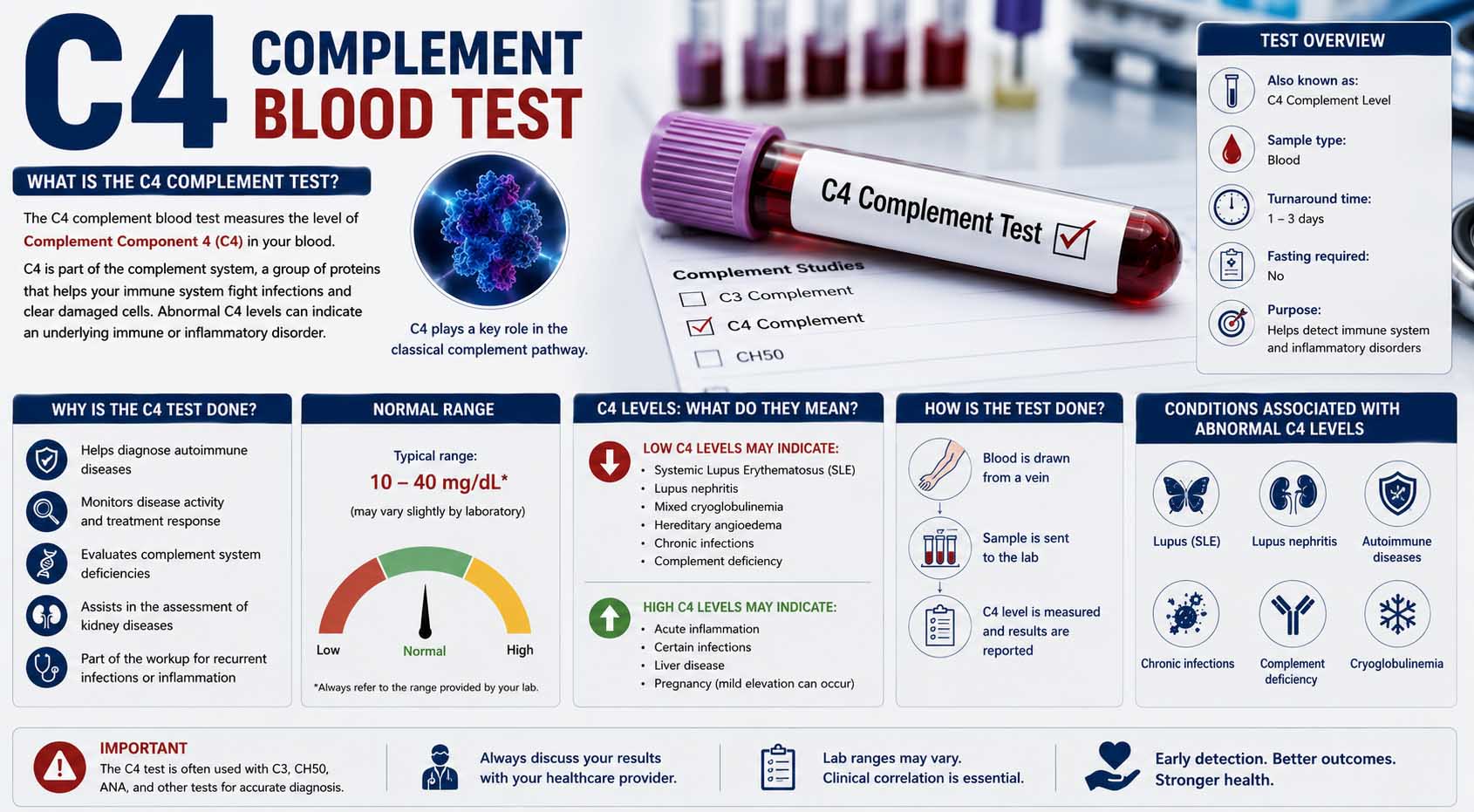
A C4 complement blood test measures the amount of complement component 4 (C4), a protein involved in your immune system’s complement pathway. Doctors may order this blood test when investigating certain autoimmune diseases, immune-system disorders, or unexplained inflammation. However, a C4 result cannot diagnose a condition by itself. Instead, healthcare professionals interpret it alongside your symptoms, medical history, physical examination, and often other laboratory tests.
Seeing an abnormal C4 value on a laboratory report can understandably raise questions. Yet both low and high results can have several explanations. Therefore, understanding what the test measures and why it was ordered can make the result easier to discuss with your healthcare professional.
What Is a C4 Complement Blood Test?
If you are wondering what is C4 complement blood test testing for, the answer starts with the complement system.
The complement system consists of proteins in the blood that work with other parts of the immune system. These proteins participate in immune responses, including helping the body recognize and clear certain microbes, damaged cells, and immune complexes.
C4 is one component of this system. It participates mainly in the classical and lectin complement pathways. When these pathways become activated, complement proteins interact in a sequence of reactions.
Doctors can measure the amount of C4 circulating in the blood. However, the number alone does not tell them why the level is abnormal.
For comparison, an nrbc blood test measures nucleated red blood cells and serves a very different clinical purpose. Therefore, even though both results may appear on laboratory reports, blood tests should be interpreted according to the specific substance or cell type being measured.
Why Is the Complement C4 Blood Test Ordered?
A doctor may order a complement C4 blood test when symptoms or other findings suggest that the complement system could be involved in an illness.
For example, complement testing may be used during the evaluation or monitoring of autoimmune conditions such as systemic lupus erythematosus (SLE). It may also be useful when healthcare professionals are investigating certain immune-complex diseases or complement deficiencies.
C4 testing can sometimes help doctors:
- evaluate possible autoimmune disease
- monitor complement activity in certain diagnosed conditions
- investigate suspected complement deficiency
- interpret other abnormal immune-system tests
- assess disease activity when complement measurements are clinically relevant
However, doctors rarely interpret C4 in isolation. They may order C3, total complement activity tests, antibody tests, inflammatory markers, kidney tests, urine tests, or other investigations depending on the clinical situation.
That broader picture matters because one laboratory value rarely explains a person’s symptoms on its own.
How the C4 Complement Blood Test Is Performed
First, a healthcare professional cleans an area of skin, usually on the inside of your elbow or another suitable location. Next, they insert a small needle into a vein and collect blood into a tube.
The process generally takes only a few minutes. You may feel a brief pinch when the needle enters the skin.
Afterward, mild bruising, tenderness, or a small amount of bleeding can occur around the needle site. Serious complications from routine blood collection are uncommon.
The laboratory then measures the concentration of C4 in your sample and reports the result using its established reference interval.
Do You Need to Fast Before the Test?
C4 testing itself generally does not require fasting. However, your healthcare professional may order other blood tests at the same time that have different preparation instructions.
Therefore, follow the instructions provided by your doctor or laboratory rather than assuming preparation is the same for every blood test.
For example, a folate blood test evaluates a nutrient rather than a complement protein and may involve different clinical considerations. Consequently, instructions should always be checked for the complete set of tests being performed.
Understanding C4 Complement Blood Test Results
Your report will usually display your C4 measurement beside the laboratory’s reference range.
Reference intervals can differ between laboratories because testing methods, units, and populations may vary. Therefore, avoid comparing your result with a random range found online.
Instead, use the reference interval printed on your own laboratory report.
A result may generally be classified as:
| C4 result | General interpretation | Possible next step |
|---|---|---|
| Within reference range | C4 concentration falls within the laboratory’s expected interval | Interpret with symptoms and other tests |
| Below reference range | C4 is lower than expected | Doctor may investigate complement consumption, deficiency, or related conditions |
| Above reference range | C4 is higher than expected | Doctor considers inflammation and the wider clinical picture |
Even a result within the reference range does not rule out every immune or autoimmune condition. Likewise, an abnormal result does not automatically confirm one.
What Does a Low C4 Level Mean?
A low C4 result can occur when complement proteins are being consumed during immune-system activation. It can also occur with certain inherited complement deficiencies or other medical conditions.
For example, reduced C4 may be seen in some people with active systemic lupus erythematosus. Doctors may therefore follow C3 and C4 levels in selected patients as part of disease monitoring.
However, low C4 does not mean you definitely have lupus.
Other clinical situations can also affect complement levels. Meanwhile, the pattern of C3 and C4 together may provide more useful information than C4 alone.
For that reason, healthcare professionals consider the test alongside symptoms, antibody results, kidney function, urine findings, and other relevant information.
A carbon dioxide blood test, for example, provides information related mainly to the body’s acid-base balance and metabolism rather than complement activity. This illustrates why doctors often combine different laboratory measurements to answer different clinical questions.
C4 Complement Blood Test High: What Can It Mean?
A C4 complement blood test high result means the measured C4 concentration is above that laboratory’s reference interval.
Complement proteins can behave as acute-phase reactants, so C4 may rise in association with inflammation. However, an elevated C4 result is generally less specific than the patterns clinicians may investigate when complement levels are low.
Therefore, a high C4 value should not be used to self-diagnose an inflammatory or autoimmune disease.
Your doctor may consider whether you have symptoms of inflammation, known medical conditions, recent illness, medications, and abnormalities in other laboratory results.
Sometimes, a mildly abnormal value has limited significance when considered alone. In other situations, it may contribute useful information when combined with several findings.
Consequently, the question is not simply whether C4 is high. Instead, the more useful question is why it was measured and what the rest of your clinical evaluation shows.
C3 and C4 Tests: Why Are They Often Checked Together?
C3 and C4 are different complement proteins. Since they participate in complement pathways, measuring them together can sometimes help clinicians recognize patterns of complement activation.
For example, particular diseases may affect both proteins, while other situations may affect one more noticeably than the other.
Still, C3 and C4 measurements are not stand-alone diagnostic tests. Doctors may combine them with tests such as antinuclear antibodies (ANA), anti-double-stranded DNA antibodies, kidney function measurements, urinalysis, or other investigations when autoimmune disease is suspected.
The exact testing plan depends on your symptoms and medical history.
Similarly, a lactic acid blood test answers a separate question by measuring lactate and may be used in very different clinical circumstances. Knowing the purpose of each test prevents unrelated blood results from being interpreted as if they measure the same body process.
Symptoms That May Lead to Complement Testing
There are no specific symptoms of “high C4” or “low C4” that reliably identify an abnormal complement level without testing.
Instead, doctors usually order complement testing because a person’s broader symptoms or medical history suggest that an immune-related condition needs investigation or monitoring.
Depending on the suspected condition, those symptoms might include unexplained joint pain or swelling, skin rashes, persistent fatigue, recurrent swelling episodes, kidney-related abnormalities, or other signs of systemic illness.
However, these symptoms have many possible causes. Therefore, experiencing them does not mean your complement level is abnormal or that you have an autoimmune disease.
A medical evaluation is needed to determine which tests, if any, are appropriate.
What Is Complement C4 Blood Test Used for in Lupus?
People researching what is complement C4 blood test often encounter information about lupus.
Systemic lupus erythematosus is an autoimmune disease in which immune activity can affect multiple organs and tissues. During certain periods of disease activity, complement proteins can be consumed, resulting in reduced C3 and C4 levels in some patients.
As a result, doctors may monitor complement levels alongside symptoms and other laboratory markers in people who have lupus.
However, complement levels do not behave identically in everyone with the disease. A person can have lupus without having low C4 at a particular time.
Therefore, C4 testing contributes one piece of information rather than serving as a yes-or-no lupus test.
Can Medications or Health Conditions Affect C4 Results?
Health conditions that influence immune activity and inflammation can affect complement measurements. Meanwhile, inherited differences in complement proteins can also influence results.
Because laboratory interpretation can be complex, tell your healthcare professional about medications, supplements, diagnosed illnesses, recent infections, and relevant family medical history.
Do not stop a prescribed medication simply because your C4 result is abnormal. Instead, discuss the result with the clinician who ordered the test.
If muscle injury or disease is being evaluated separately, a CK blood test may be ordered because creatine kinase reflects muscle-related processes rather than complement-system activity. Again, the clinical reason behind a test determines how its result should be interpreted.
What Happens After an Abnormal C4 Result?
An abnormal C4 level does not automatically mean treatment is necessary.
Instead, treatment targets the underlying condition, if one is identified. Therefore, there is no standard medication designed simply to make every abnormal C4 number return to normal.
Your healthcare professional may first review your symptoms and previous test results. Next, they may repeat the test, measure other complement proteins, or order additional blood and urine studies.
For example, if autoimmune disease is suspected, additional antibody testing may help clarify the diagnosis. Meanwhile, kidney testing may become relevant if symptoms or other results suggest kidney involvement.
In some cases, no immediate intervention may be needed beyond follow-up. In others, an established medical condition may require treatment and monitoring.
Common Misunderstandings About C4 Testing
“Low C4 automatically means lupus.”
No. Although low complement levels can occur in lupus, several other conditions and inherited complement deficiencies can affect C4. Doctors need additional clinical and laboratory evidence to diagnose lupus.
“High C4 means my immune system is stronger.”
Not necessarily. A higher concentration does not simply translate into a stronger or healthier immune system. Inflammation and other factors may influence complement proteins.
“A normal C4 result means I have no autoimmune disease.”
No. Normal complement levels cannot exclude all autoimmune diseases. Instead, diagnosis depends on the overall clinical picture.
“I should change my diet to correct C4.”
There is no standard diet proven to normalize C4 regardless of its cause. Instead, medical care focuses on identifying and managing any underlying condition.
FAQs About the C4 Complement Blood Test
What is C4 complement blood test measuring?
It measures complement component 4, a protein involved in immune-system complement pathways. Doctors use the result as part of the evaluation or monitoring of selected immune and autoimmune conditions.
Is a C4 complement blood test used to diagnose lupus?
C4 can contribute useful information when lupus is suspected or monitored, but it cannot diagnose lupus by itself. Doctors consider symptoms, physical findings, antibody tests, and other laboratory results as well.
Is low C4 dangerous?
A low value is a laboratory finding rather than a diagnosis. Its significance depends on why it is low, whether other complement results are abnormal, and what symptoms or medical conditions are present.
Should I worry about a high C4 level?
An elevated C4 result does not automatically indicate a serious disease. Since C4 may rise with inflammation and other factors, your healthcare professional should interpret the result within your complete medical picture.
How often should C4 be tested?
There is no universal testing schedule. Some people may need only one measurement during an evaluation, while patients with certain diagnosed conditions may have levels monitored over time.
Can C4 levels change over time?
Yes. Complement measurements can change as immune activity and health conditions change. Therefore, trends may sometimes provide useful information when a clinician is monitoring an established condition.
Making Sense of Your C4 Result
A C4 complement blood test can provide useful information about part of the immune system, especially when doctors are evaluating or monitoring certain autoimmune and complement-related conditions. Still, low, normal, and high values cannot be interpreted accurately without context.
Therefore, check your result against the reference range supplied by the laboratory, but avoid trying to diagnose yourself from the number alone. Instead, review the result with the healthcare professional who ordered the test, particularly if other laboratory findings are abnormal or you have ongoing symptoms.
If further testing is recommended, ask what each test is looking for and how it relates to your C4 result. That approach can help you understand the bigger clinical picture without giving one laboratory number more meaning than it actually has.