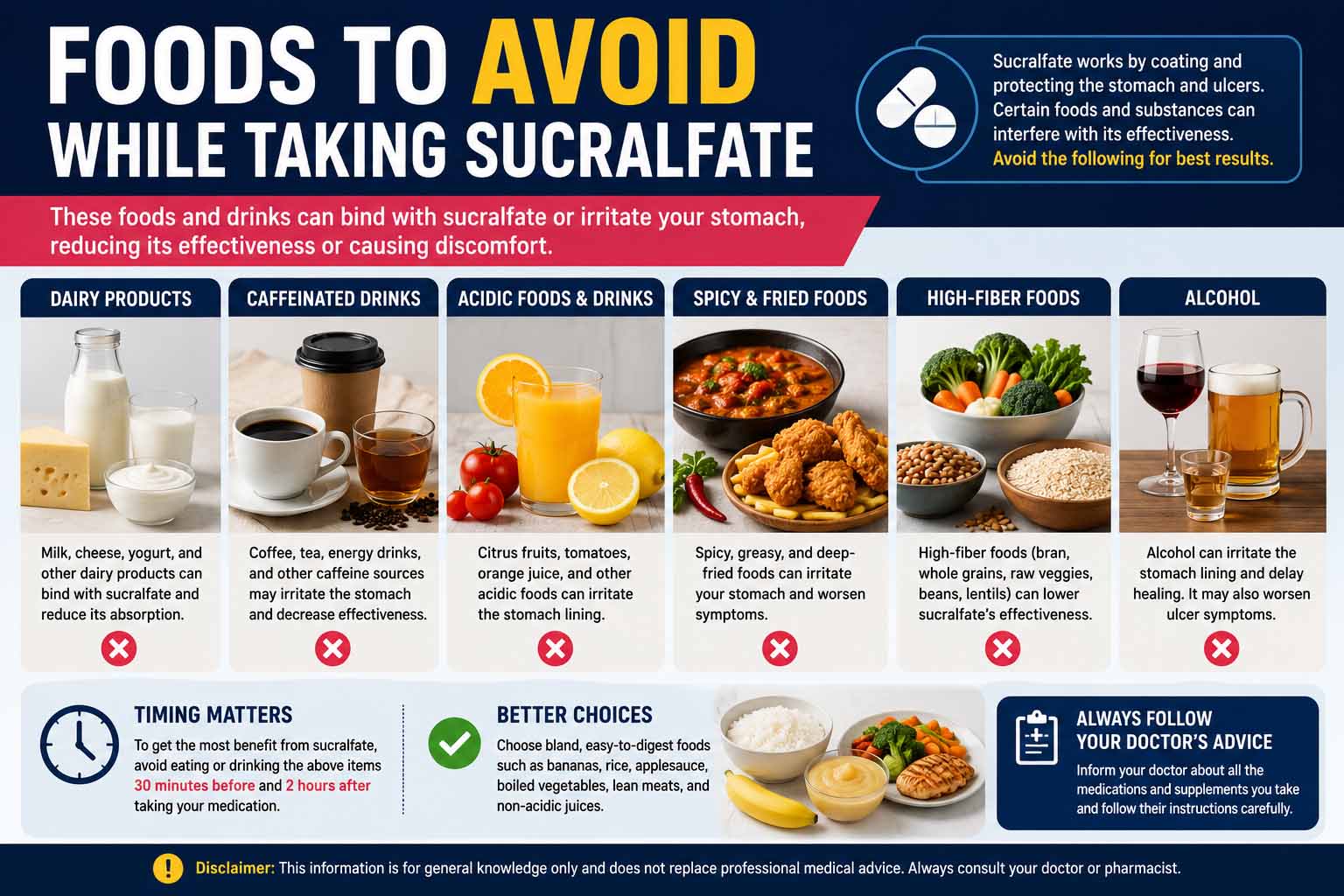
If you are searching for foods to avoid while taking sucralfate, the most useful answer is that there is no standard list of foods everyone must eliminate. Instead, timing matters more than the specific food you eat. Sucralfate is generally taken on an empty stomach, usually 1 hour before or 2 hours after meals, because food can interfere with how the medicine coats and protects damaged tissue. Unless your healthcare professional gives you a special diet, you can generally continue your normal diet.
However, the condition being treated may make certain foods uncomfortable. For example, spicy, acidic, fatty, or heavily caffeinated foods and drinks can worsen upper digestive symptoms in some people even though they do not have a specific dangerous interaction with sucralfate.
That distinction matters. The goal is not to create an unnecessarily restrictive diet. Instead, take sucralfate correctly, notice which foods aggravate your symptoms, and follow any dietary advice your doctor has given you.
What Is Sucralfate and Why Does Food Timing Matter?
Sucralfate is a gastrointestinal protectant. It is commonly prescribed for duodenal ulcers and may be used in other situations when a clinician wants to protect damaged tissue in the upper digestive tract.
Rather than reducing stomach acid in the same way as proton pump inhibitors or H2 blockers, sucralfate attaches to damaged ulcer tissue. As a result, it forms a protective barrier against stomach acid and digestive enzymes while the area heals.
For that reason, the medicine needs the right conditions to work as intended.
MedlinePlus advises taking sucralfate on an empty stomach, specifically about 1 hour before meals or 2 hours after meals. It should also be taken at roughly the same times each day according to the prescription.
So, rather than asking only “Which foods are prohibited?”, it is more helpful to ask “When should I eat after taking sucralfate?”
For most prescriptions, waiting about an hour after the dose before eating follows standard guidance. However, always use the directions on your own prescription label because dosing schedules can vary.
Foods to Avoid While Taking Sucralfate at the Same Time
The main thing to avoid is eating any meal or substantial snack at the same time as your sucralfate dose unless your prescriber has given you different instructions.
That does not mean those foods are permanently off limits.
For example, breakfast may contain eggs, oatmeal, fruit, or toast. foods to avoid while taking sucralfate Those foods are not inherently incompatible with sucralfate. Instead, you would normally take the medication at the prescribed time before eating rather than swallowing it together with breakfast.
The same principle applies to lunch, dinner, and snacks.
A simple schedule might look like this:
| Situation | General timing guidance |
|---|---|
| Taking sucralfate before breakfast | Take it about 1 hour before eating |
| Taking it after a meal | Wait about 2 hours after eating |
| Eating after a sucralfate dose | Generally wait about 1 hour |
| Taking an antacid | Keep it at least 30 minutes away from sucralfate |
| Other medicines | Ask a pharmacist about appropriate spacing |
These are general guidelines rather than a substitute for your individual prescription instructions.
Spicy Foods: Avoid Them Only If They Trigger Symptoms
There is no general rule stating that everyone taking sucralfate must stop eating spicy food.
However, hot peppers, chili-heavy dishes, spicy sauces, and similar foods may aggravate burning, discomfort, or reflux-like symptoms in some people.
If spicy meals consistently make you feel worse, reducing them while your digestive tract heals is reasonable.
On the other hand, if you tolerate spicy foods without symptoms and your clinician has not told you to avoid them, sucralfate itself does not automatically require their elimination.
Keeping a short food-and-symptom diary can help identify genuine triggers instead of removing foods based on assumptions.
Acidic Foods and Drinks
Acidic foods are another category that often gets labeled as “forbidden,” although the real situation is more individual.
Possible triggers include citrus fruits, tomato-based sauces, vinegar-heavy foods, and acidic beverages.
Some people with upper gastrointestinal irritation notice increased discomfort after consuming these products. Others tolerate them well.
Therefore, do not assume that oranges, tomatoes, or lemons directly cancel the effect of sucralfate. Instead, reduce foods that repeatedly worsen your symptoms and discuss ongoing pain, burning, or nausea with your healthcare provider.
Persistent symptoms can require reassessment of the underlying condition rather than increasingly restrictive diets.
Coffee, Tea, and Other Caffeinated Drinks
Coffee does not have to be universally banned while taking sucralfate.
Still, coffee and other caffeinated beverages can aggravate heartburn or upper digestive symptoms in certain people. Large amounts of caffeine can also make some people feel jittery or uncomfortable.
Timing matters here as well.
Because sucralfate is supposed to be taken on an empty stomach, do not casually replace the required empty-stomach period with coffee, a latte, or another caloric drink unless your healthcare professional has said that is acceptable.
Water is usually the simplest drink for taking an oral medication unless its instructions state otherwise.
If coffee noticeably worsens stomach discomfort, consider reducing the amount, choosing a less irritating option, or discussing your symptoms with your clinician.
Alcohol and Digestive Irritation
Alcohol is not listed as a specific food interaction that everyone taking sucralfate must avoid.
However, alcohol can irritate the digestive tract and may worsen symptoms in some people with ulcers or other upper gastrointestinal problems.
The bigger question is therefore why you are taking sucralfate.
If your stomach or intestinal lining is already irritated or ulcerated, regular alcohol use may work against your broader recovery plan. In addition, alcohol can interact with other medicines you may be taking even if it does not have a major direct interaction with sucralfate itself.
Ask your doctor or pharmacist whether alcohol is appropriate given your diagnosis and full medication list.
High-Fat Meals May Worsen Symptoms for Some People
Fried foods, very fatty meals, and rich fast foods do not chemically “neutralize” sucralfate.
However, high-fat meals can aggravate digestive discomfort in some people, particularly if they also experience reflux, nausea, bloating, or delayed stomach emptying.
Examples include deep-fried foods, heavily greasy meals, rich cream sauces, and very fatty portions of meat.
Again, individual tolerance matters.
A food that bothers one person may cause no symptoms in another.foods to avoid while taking sucralfate Therefore, focus on your own pattern rather than following an unnecessarily strict internet list.
Smaller, balanced meals may feel easier to tolerate while gastrointestinal symptoms are active.
Fiber Is Not Automatically a Problem
People sometimes worry that fiber-rich foods will interfere with sucralfate. In general, there is no standard recommendation to avoid dietary fiber solely because you use this medicine.
In fact, constipation is a recognized side effect of sucralfate.
For people who can tolerate them, fruits, vegetables, whole grains, legumes, and other foods high in fiber can form part of a healthy diet and may support regular bowel movements.
However, suddenly increasing fiber by a large amount can cause gas, bloating, or abdominal discomfort.
Your underlying digestive condition also matters. Certain gastrointestinal problems may require temporary dietary changes, so follow your clinician’s instructions if you have been advised to restrict fiber.
Be More Careful With Fiber Supplements
Fiber from ordinary food and concentrated fiber supplements are not exactly the same situation.
Fiber supplements can affect how quickly substances move through the gastrointestinal tract, and some supplements may interfere with the absorption of certain medications.
Therefore, if you use psyllium or another concentrated product, ask your pharmacist how far apart it should be taken from sucralfate and your other medicines.
The best time to take fiber supplement products depends partly on the specific supplement and medication schedule, so avoiding simultaneous dosing is often easier than guessing.
Also, do not automatically start a high-dose fiber supplement because sucralfate causes constipation. Increasing fiber without enough appropriate fluid or without considering your medical condition can sometimes make constipation or bloating worse.
Medication Interactions Matter More Than Most Foods
For many people, spacing sucralfate from other medications is a bigger concern than avoiding individual foods.
Sucralfate can interfere with the absorption of some oral medicines because of its coating and binding effects.
That means your doctor or pharmacist may tell you to separate another medicine from your sucralfate dose by a specific period.
Do not assume that two medications are safe to swallow together simply because both prescriptions say they should be taken in the morning.
Your pharmacist can review the entire schedule and identify which products need separation.
MedlinePlus also advises telling your healthcare team about all prescription medicines, over-the-counter medicines, vitamins, nutritional supplements, and herbal products you use.
Keep Antacids Away From Your Sucralfate Dose
Antacids deserve special attention because people with ulcer or heartburn symptoms may use them frequently.
MedlinePlus recommends taking antacids at least 30 minutes before or after sucralfate.
Therefore, do not automatically take an antacid alongside your sucralfate because your stomach hurts.
Check the timing first.
If you regularly need antacids despite taking your prescribed treatment, tell your healthcare provider. Ongoing symptoms may mean that your treatment plan needs review.
What Should You Eat While Taking Sucralfate?
There is no special “sucralfate diet” that works for everyone.
Unless your clinician has given you different instructions, MedlinePlus says you can continue your normal diet.
Still, people with active stomach or upper intestinal discomfort often find simple, balanced meals easier to tolerate.
Possible choices include oatmeal, rice, potatoes, cooked vegetables, bananas, lean protein, eggs, soups that are not heavily spicy, toast, and other familiar foods that do not trigger symptoms.
This is not a required menu.
Likewise, low fiber foods may occasionally be recommended for specific digestive conditions or procedures, but taking sucralfate alone is not a reason to switch to a low-fiber diet.
Choose foods according to your diagnosis, symptoms, nutritional needs, and professional dietary advice.
A Practical Sucralfate Meal Schedule
A four-times-daily prescription can make food timing feel complicated.
For example, a clinician may prescribe doses before meals and at bedtime. However, you should follow your actual prescription rather than copying someone else’s schedule.
A practical routine often starts by working backward from your regular meal times.
If breakfast is at 8:00 a.m., for example, a prescribed pre-breakfast dose might be scheduled around 7:00 a.m. Lunch and dinner doses can follow the same general principle if that matches the instructions.
Consistency helps because sucralfate needs regular use to work effectively. Treatment for ulcers may continue for several weeks, and MedlinePlus notes that healing can take up to about eight weeks.
Phone alarms can be useful when meals and several daily doses are difficult to coordinate.
Common Mistakes to Avoid
One frequent mistake is swallowing sucralfate with breakfast because taking medicines with food feels more natural.
However, sucralfate is generally intended for an empty stomach.
Another mistake is taking all morning medications together. Some drugs may need to be separated from sucralfate, so check your medication schedule with a pharmacist.
People also sometimes overcorrect their diet.
They remove dairy, fruit, tomatoes, fiber, coffee, spices, and numerous other foods at once even though many of those foods may not bother them. Such restriction can make eating unnecessarily difficult without improving treatment.
Instead, start with correct medication timing and eliminate foods only when they clearly trigger symptoms or your clinician recommends it.
When to Contact a Healthcare Professional
Sucralfate commonly causes constipation, although not everyone develops it.
Contact your healthcare provider if constipation becomes persistent or severe, particularly if you also develop significant abdominal pain, vomiting, abdominal swelling, or difficulty passing stool.
Sucralfate also contains aluminum, so people with kidney disease need special medical consideration. MedlinePlus specifically recommends telling your doctor if you have kidney disease, diabetes, swallowing difficulties, certain gastrointestinal problems, or enteral tube feeding.
Seek urgent care for signs of a serious allergic reaction such as trouble breathing or swallowing, facial or throat swelling, or widespread hives.
Frequently Asked Questions About Foods and Sucralfate
Can I eat immediately after taking sucralfate?
Usually, no. Standard guidance is to take sucralfate on an empty stomach about 1 hour before food or 2 hours after a meal. Follow your own prescription instructions.
Can I drink milk with sucralfate?
There is no standard requirement to permanently avoid milk. However, because sucralfate is generally taken on an empty stomach, taking your dose together with milk would not match the usual empty-stomach instructions. Use water unless your clinician or pharmacist advises otherwise.
Can I eat dairy products while taking sucralfate?
Generally, dairy foods do not need to be eliminated merely because you take sucralfate. Instead, separate your medicine from meals as prescribed and avoid foods that worsen your symptoms.
Should I avoid spicy food completely?
Not necessarily. Spicy food does not have a universal dangerous interaction with sucralfate. However, if it consistently aggravates your stomach or ulcer symptoms, reducing it may make you more comfortable.
Can I take sucralfate after eating?
Yes, but standard guidance generally calls for waiting about two hours after a meal so that the stomach is empty.
What happens if I accidentally take sucralfate with food?
A one-time timing mistake is generally different from an overdose or emergency. Do not double your next dose to compensate. Resume your prescribed schedule, and ask your pharmacist if you are uncertain about what to do.
The Main Rule Is Timing, Not a Forbidden-Food List
When considering foods to avoid while taking sucralfate, remember that most people do not need to permanently eliminate a long list of foods. The key instruction is usually to keep meals away from the dose so the medicine can work on an empty stomach.
Meanwhile, limit spicy, acidic, fatty, caffeinated, or alcoholic products only when they worsen your symptoms or conflict with advice for your underlying condition.
Most of all, pay attention to your entire medication schedule.foods to avoid while taking sucralfate Sucralfate can affect the absorption of other medicines, and antacids need specific spacing as well. A pharmacist can help build a practical schedule around meals, prescriptions, supplements, and bedtime.
That approach is safer—and usually much easier—than treating every ordinary food as a possible sucralfate interaction.